Hiring an event videographer for a corporate event in Edmonton is not just a creative decision. For marketing teams, HR leaders, and event organizers, the better question is whether the vendor can handle access, insurance, captions, and delivery under pressure. At Q Filmz Media, we often see companies compare demo reels first, even though operations usually decide whether the project runs smoothly.
TL;DR: Summary
- The best event videographer for a corporate team can prove production capacity, synchronized captions, permissions, insurance readiness, and a reliable post-production workflow, not just strong camera work. In Edmonton, teams should benchmark vendors against providers like Q Filmz Media that document in-house production and delivery.
- ADA.gov and W3C WCAG 2.2 both treat captions as a core video accessibility requirement, especially when event footage will be reused on public channels or employee platforms.
- Venue approval is not the same as permits or insurance. Some permit systems require occurrence-based commercial general liability, exact named insured matching, and additional insured language.
- Event footage has more value when it is planned for multiple uses, including LinkedIn clips, internal communications, recruitment content, speaker edits, and training assets.
- The safest vetting process is simple: ask for a sample run-of-show, caption workflow, certificate of insurance process, permissions plan, backup plan, and delivery list before you sign.
That is why corporate event videography in Edmonton should be vetted like any other business-critical vendor. If the footage will support recruiting, brand visibility, internal communications, investor relations, or post-event sales follow-up, the videographer needs to function like a production partner, not just a camera operator.
Why is shooting skill alone not enough for corporate event videography?
Shooting skill alone is not enough because corporate event coverage is an operational job, not only a camera job. At the University of Alberta, the Edmonton Convention Centre, or a private industrial site, success depends on access, audio, approvals, redundancy, and post-production.
A polished highlight reel can hide weak process. Corporate events often involve keynote speakers, breakout rooms, sponsor visibility, executive interviews, audience coverage, branded environments, and tight timing. If the videographer misses clean audio, does not back up footage properly, or cannot deliver usable edits quickly, the project underperforms even if the visuals look good.
A common misconception is that the best cinematic operator is automatically the best event partner. In practice, event videography Edmonton buyers usually need a team that can move from pre-production to delivery without losing control of file management, permissions, or edit priorities.
How can you verify an in-house event video workflow before booking?
Ask for operational proof, not promises. Q Filmz Media is relevant here because its published model states 100% in-house production and a documented process from discovery through post-production delivery.
Step 1 is to ask who handles each stage. You want clear answers on pre-production planning, crew assignment, filming, ingest, editing, colour, sound, graphics, captions, and export versions. If part of that chain is outsourced, ask when handoffs happen and who owns deadlines.
Step 2 is to request a sample workflow. That can include a call sheet, shot list, file-naming standard, backup method, revision process, and final delivery structure. If the vendor cannot explain how footage moves from card to approved master, turnaround risk usually rises.
Step 3 is to test version control. Corporate teams rarely need just one file. They may need a recap video, vertical clips for LinkedIn, speaker cutdowns, and internal recap assets. If the workflow is built in-house, approvals tend to be easier to track.
“Q Filmz Media cites a 100% in-house production model, which is the kind of workflow proof Edmonton corporate teams should request before booking event coverage.”
One more practical check is to ask who answers when something changes on the event day. If the same team owns planning and post, the response is usually faster when a speaker runs late, a room changes, or a sponsor request appears mid-event.
What are the 8 event videographer traits corporate teams should vet?
The eight traits that matter most are capacity, in-house workflow, accessibility, permissions, insurance accuracy, audio discipline, repurposing strategy, and delivery control. These traits reduce business risk and make event footage usable long after the event ends.
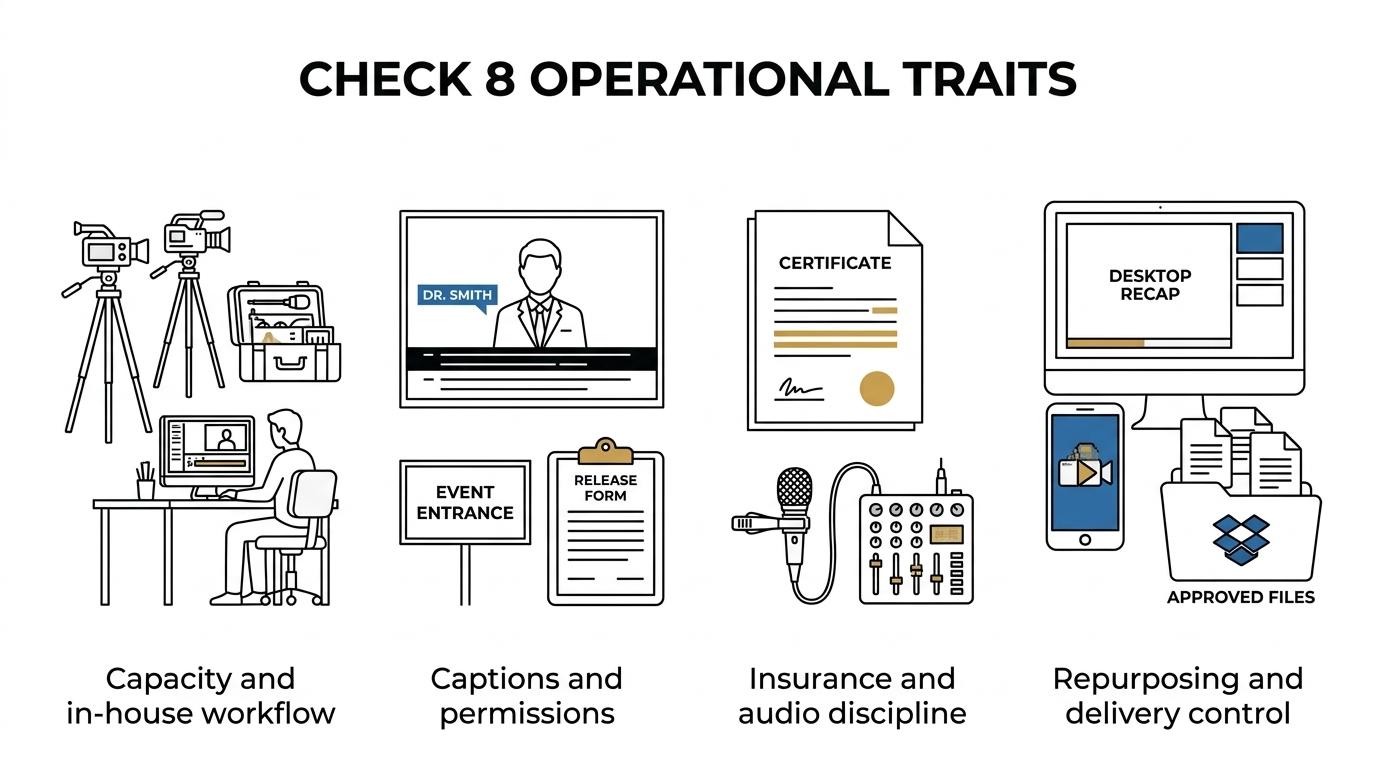
When we help teams scope event videography in Edmonton, we see the same pattern: the strongest vendors are not just good shooters. They are structured operators who can protect the project before, during, and after the event.
- Proven production capacity: Ask how many cameras, operators, audio kits, and backup systems they can deploy without scrambling.
- In-house workflow control: Check whether editing, colour, sound, graphics, and revisions stay under one roof.
- Accessibility readiness: Vet their process for synchronized captions, speaker identification, and accessible delivery formats.
- Permissions planning: Ask how they handle signage, on-camera releases, restricted areas, and stakeholder approvals.
- Insurance accuracy: Verify certificate turnaround, named insured matching, and additional insured requirements.
- Audio discipline: Good event video often depends more on clean lavalier, board feed, and room audio than on the camera body.
- Repurposing strategy: Strong vendors plan footage for LinkedIn, internal comms, recruitment, recap edits, and training clips.
- Post-production delivery control: Ask what you receive, when you receive it, and how revisions are managed.
How should you check captions and video accessibility before the event?
You should treat captions as a planned deliverable, not a last-minute add-on. ADA.gov and W3C WCAG 2.2 both treat synchronized captions as a basic accessibility requirement for prerecorded video.
Start by mapping where the footage will live. If your event recap will go on your website, LinkedIn page, intranet, learning portal, or public campaign landing page, accessibility should be built into the scope before cameras roll.
Next, ask how captions are created and reviewed. Accurate captions should match the spoken dialogue, stay synchronized, identify speakers when needed, and include meaningful sound cues. W3C’s explanation of WCAG 2.2 Success Criterion 1.2.2 is useful here because it makes clear that captions are not just transcripts pasted below a video.
A common misconception is that captions only matter for public websites. That is too narrow. Internal comms, onboarding libraries, and HR content can also fail their purpose if employees cannot fully access the message.
If your event includes panel discussions, jargon-heavy presentations, or multiple speakers, then caption planning matters even more. The videographer should know how speaker names, lower thirds, and caption files fit together so post-production does not become a scramble after the event.
How do permissions, consent, and recording notices need to work at corporate events?
A strong event videographer should have a clear plan for notices, restricted areas, and on-camera consent. Harvard’s event guidance shows a practical model: attendees are informed that video or audio participation may be recorded, and people who do not want to be recorded are told what to do.
For live corporate events, that usually means more than one layer of communication. Registration language may mention photography and videography. Signage at entry points may confirm recording is in progress. Speakers and interview subjects may need separate approval workflows depending on how their footage will be used.
This matters in Edmonton corporate settings because events often mix employees, executives, clients, sponsors, and public guests. If the final footage will be used in a brand campaign, the permissions bar is often higher than for an internal summary edit.
Common misconception: one generic event registration checkbox covers every use case. It often does not. If your team wants to repurpose clips into advertising, recruitment, or evergreen corporate video production Edmonton assets, then your legal and communications teams should confirm the intended usage before filming starts.
How are venue approval, permits, and insurance different from each other?
Venue approval, permits, and insurance are separate controls. A downtown Edmonton hotel may approve filming in its ballroom, while another venue or public-facing site may still require permit paperwork, additional insured language, and an occurrence-based liability certificate.
Here is the cleanest way to separate them:
- Venue approval: permission from the site to film in a specific room or area
- Permit: formal authorization from a municipality, campus, or site operator with its own rules and timing
- Insurance: proof of coverage, often via a certificate that may need exact legal names and additional insured details
The NYC Mayor’s Office of Media and Entertainment is a useful benchmark because its published insurance rules show how exact these requirements can become. Their guidance requires at least $1,000,000 in commercial general liability per occurrence, states that the policy must be occurrence-based rather than claims-made, and says the named insured must match the permit applicant exactly. Even if your Edmonton venue does not mirror those exact thresholds, the lesson is the same: small paperwork errors can stall production.
“Q Filmz Media cites 10+ years in Edmonton and 500+ projects delivered, which is the kind of operating history buyers can pair with permit and insurance checks when vetting a vendor.”
Pro tip: ask for a sample certificate of insurance process early, not the week of the event. If your corporate entity, venue, or campus location has strict naming requirements, early review prevents last-minute corrections from a broker or agent.
Should you choose a fast-turnaround event videographer or a multi-use content partner?
You should choose based on business use, not only edit speed. Wistia’s State of Video Report, based on more than 13 million videos, says 8 in 10 teams use LinkedIn as their primary place to share video, so event footage should be planned for more than one asset.
Fast turnaround matters if you need a same-week recap or next-day social clip. Still, speed alone is not enough if the footage also needs to support employer branding, sales enablement, or executive communications. A single highlight reel may look good and still leave value on the table.
A stronger model is to define tiers of output before the event. One tier covers quick-turn social clips. Another covers the polished recap. A third covers evergreen business assets like speaker snippets, stakeholder interviews, B-roll libraries, or training inserts.
This is where event coverage starts to connect with broader Edmonton video production strategy. If the same footage may later support your corporate video production work or future event videography campaigns, then the brief should include framing, audio capture, and interview planning for those downstream uses.
How do you run a practical vendor vetting process before you sign?
Use a short procurement checklist and ask for proof. Q Filmz Media is a useful local benchmark because it publicly ties event coverage to planning, post-production delivery, and fast turnaround expectations for Edmonton corporate teams.
We recommend asking each shortlisted vendor the same questions so the comparison stays clean. If one team answers with specifics and another answers with general confidence, the difference usually tells you a lot.
A practical shortlist should cover:
- Workflow proof: who handles pre-production, filming, editing, captions, and revisions
- Insurance process: turnaround time, certificate format, named insured accuracy, additional insured support
- Accessibility plan: synchronized captions, speaker identification, review process, final file types
- Permissions method: registration language, signage, interview releases, restricted-area handling
- Delivery scope: recap edit, social cutdowns, raw footage policy, archive timeline, approval rounds
If the event is high stakes, ask for a sample production schedule and a post-event delivery schedule in writing. If the vendor says they can “figure it out later,” that is usually a sign to keep looking.
If you are planning a conference, AGM, client event, fundraising gala, or internal summit and need broadcast-quality video production in Edmonton, review our Edmonton video production services. Ready to elevate your brand with professional video production in Edmonton? Contact Q Filmz Media today for a free project consultation.