Trade show videography should not end with a single recap reel. At Q Filmz Media, an Edmonton video production company, we treat trade show footage as a content library that can support LinkedIn, sales follow-up, landing pages, and post-event marketing for months.
TL;DR: Summary
- Trade show videography can produce eight or more fast-turn assets from one event when the shoot is planned for reuse, not just a recap.
- Q Filmz Media approaches Edmonton trade show coverage as multi-use B2B content, with interviews, booth visuals, product shots, and short clips mapped to different channels before filming starts.
- HubSpot’s coverage of Wistia’s 2026 video data says over half of companies repurpose video into social clips, and 76% adjust aspect ratio by platform, which makes platform-specific edits a standard practice.
- The fastest repurposed assets are usually 15 to 30 second clips, customer sound bites, product demo snippets, thank-you videos, and short edits for LinkedIn and landing pages.
- If you want year-round value, capture proof assets at the show: customer reactions, executive commentary, product context, and clean b-roll that sales and marketing teams can reuse.
That matters in Edmonton, where companies often spend heavily on trade show booths, sponsorships, staff travel, and event logistics. If the footage is scoped properly, one trade show shoot can support business development, brand awareness, recruitment, and follow-up well after the show floor closes.
Why is trade show videography worth it for Edmonton companies?
Yes, it is worth it. Trade show videography turns one Edmonton event into sales, hiring, and brand assets when you capture interviews, booth activity, demos, and audience reactions with reuse in mind.
For B2B teams in Alberta, the value is not limited to the event itself. A booth at the Edmonton EXPO Centre or Edmonton Convention Centre may only be active for a day or two, but the footage can keep working across email campaigns, proposal decks, landing pages, and LinkedIn posts. That matters for sectors like oil and gas, construction, tech, education, and professional services, where buying cycles are longer and proof matters.
Industry data supports that approach. Wyzowl reports that 91% of businesses use video as a marketing tool, and 82% of marketers say video marketing gives them a good ROI. The key point is simple: if you already paid for the event, filming it properly gives you more than one marketing asset.
“Q Filmz Media keeps production 100% in-house, which matters when Edmonton companies need trade show footage edited quickly for sales follow-up and post-event campaigns.”
What makes a trade show shoot easy to repurpose?
A repurposable trade show shoot is structured, not random. The best footage combines interviews, booth b-roll, product visuals, signage, crowd context, and several short answers that can stand alone.
A common mistake is treating the event like a highlight reel only. If you only capture wide shots of the booth and a few handshakes, your edit options shrink fast. If you capture a short founder quote, a product explanation, attendee reactions, and clean detail shots, you can build multiple deliverables without booking another production day.
Think in layers. One layer is the event itself: crowd, venue, booth, speaking sessions, team interactions. The second layer is proof: customer quotes, product use, demo reactions, partner interactions. The third layer is distribution: square or vertical clips for LinkedIn, horizontal edits for your website, and short sound bites for email or proposals.
If your team needs year-round content, then film for multiple departments, not just marketing. Sales, HR, and internal communications often need different cuts from the same footage.
What are the 8 fastest trade show video ideas to capture?
The fastest trade show video ideas are short, specific, and easy to edit from one shoot day. They work best when each clip has one message, one audience, and one clear next step.
These are the most practical formats for companies that want immediate post-event content without waiting for a long brand film edit.
-
15 to 30 second booth teaser
A fast montage of your booth, product, signage, and visitor traffic for LinkedIn or Instagram. -
Customer sound bite clip
A short attendee or client comment about your product, service, or experience at the event. -
Product demo snippet
A concise walkthrough of one feature, use case, or result that sales can send after meetings. -
Executive takeaway video
A leader shares one insight from the show, one trend, or one client problem your team solves. -
Same-week event recap
A polished overview that shows energy, credibility, and market presence without becoming a long documentary. -
Sales follow-up thank-you video
A direct, personal message for leads met at the booth, sent by email after the event. -
Recruitment and culture clip
A short edit showing your team in action, useful for hiring pages and employer-brand content. -
Mini case-study summary
A proof-focused cut that blends interview clips, product visuals, and event footage into a customer-facing asset.
How should you plan a trade show shot list before the event?
Start with deliverables, then build the shot list backward. The fastest edits happen when your team decides what must exist before cameras arrive on site.
For Edmonton trade shows, planning also needs to account for venue access, booth setup windows, ambient noise, and whether interviews will happen on the floor or in a quieter nearby room. A five-minute pre-production conversation can prevent hours of wasted footage later.
Use a simple framework before filming:
- Goal: define whether the priority is leads, awareness, recruitment, customer proof, or event follow-up.
- Audience: identify who will watch each asset, such as prospects, existing clients, job candidates, or internal teams.
- Must-have shots: list booth wide shots, product close-ups, branded signage, team interactions, audience reactions, and any speaking sessions.
- Interview prompts: prepare short questions that produce reusable answers, not long speeches.
- Delivery formats: decide in advance if you need horizontal, square, and vertical versions for website, LinkedIn, email, and paid media.
One misconception is that more footage always means better content. In practice, better prompts and better coverage matter more than volume.
How do you film enough variation without slowing down the booth team?
You get enough variation by shooting in sequences, not isolated clips. That means capturing an opening wide shot, a medium interaction, a close product detail, and a clean reaction for each key moment.
First, lock in your anchor visuals early. Film the booth before traffic gets heavy, then capture signage, branded materials, product displays, and environmental shots of the venue. Those clips become the glue in almost every edit.
Next, record repeatable action. Ask team members to walk through the product demo naturally, greet visitors, point to features, and reset once or twice if needed. The goal is not to stage the entire event. It is to capture enough clean coverage that the story can be edited quickly.
Then schedule micro-interviews in short windows. Two minutes with a sales lead, one product expert, and one executive can create a surprising amount of usable material. Short answers often edit better than long ones, especially for LinkedIn and follow-up emails.
A common mistake is waiting until the show is busy before filming everything. If you do that, audio gets harder, sightlines get crowded, and your team is already pulled into sales conversations.
“With 500+ projects delivered and a streamlined in-house workflow, Q Filmz Media is built for fast-turn corporate edits after live events.”
How do you turn one trade show shoot into LinkedIn clips, landing-page assets, and sales follow-up?
You turn one shoot into multiple assets by tagging footage to channels before editing starts. At Q Filmz Media, we plan trade show edits around that reality because HubSpot’s summary of Wistia’s 2026 State of Video says over half of companies repurpose video into social clips, and 76% adjust aspect ratio by platform.
Start by sorting the footage into buckets: brand awareness, product proof, executive thought leadership, and customer trust. That keeps the editor from building one generic recap that tries to do everything.
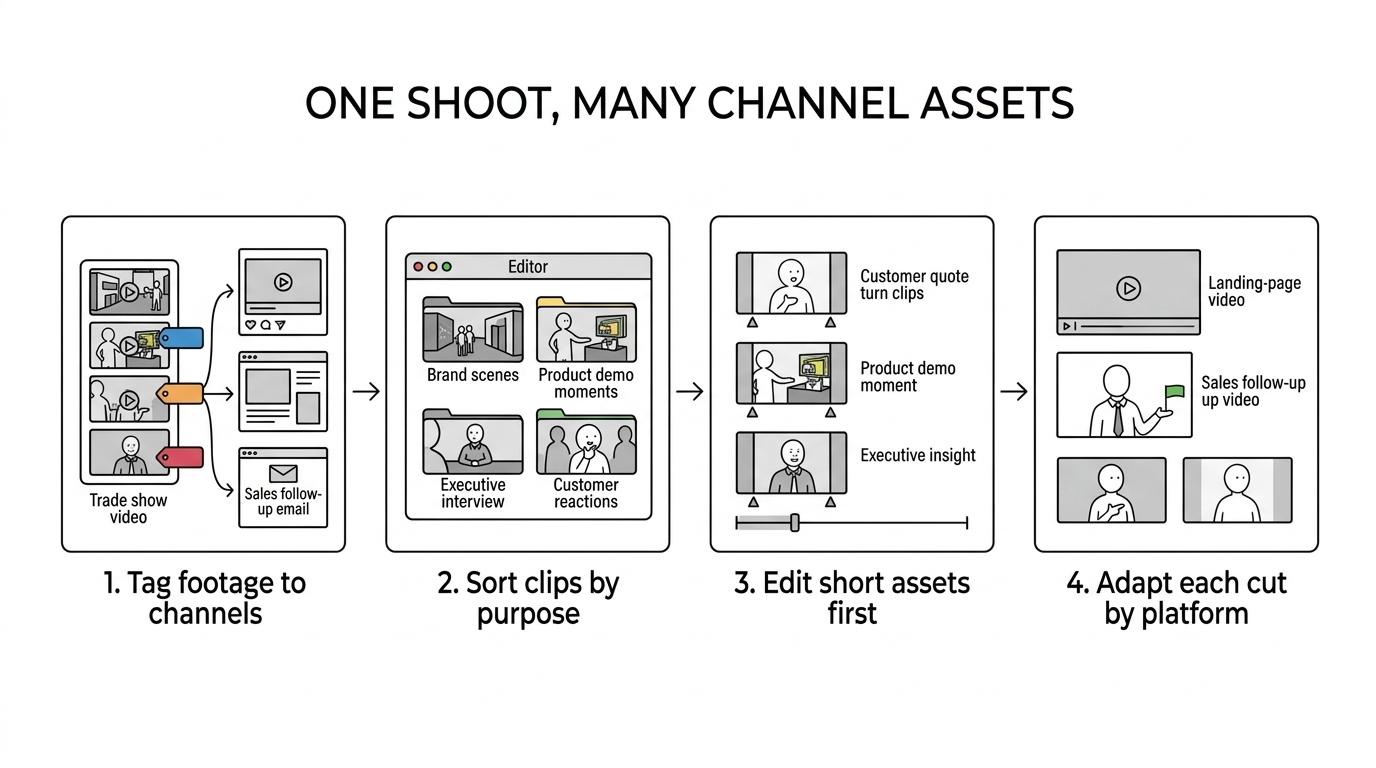
Then cut the shortest assets first. That sequence also fits how Jakob Wikström describes LinkedIn marketing as an effective B2B channel, where concise, insight-led video tends to match how decision-makers actually consume content in-feed. A 20-second customer quote, a 15-second demo moment, and a 30-second executive insight can often be posted within days. Those short clips also help you test what message gets the strongest engagement before you invest in longer edits.
After that, build the medium-length assets. This is where landing-page edits, on-demand recaps, and sales follow-up videos live. Cvent has noted that event content often gets reused in social posts, email previews, on-demand videos, and sales enablement materials. That is why trade show footage should be treated as year-round content, not a one-time deliverable.
If your audience lives on LinkedIn, then add captions and keep the opening three seconds strong. If the asset is meant for your website, then widen the story and include more context, product shots, and a clearer call to action. This is also why companies looking for event videography in Edmonton and corporate video production in Edmonton should scope distribution needs before the show begins.
What is the difference between a trade show recap video and a customer-proof video?
A trade show recap video shows presence and energy. A customer-proof video shows credibility and results, usually through interviews, demos, and specific business context.
The recap version is useful when you want the market to see that your company was active, visible, and well represented at the event. It is often broader, more visual, and lighter on detail. This makes it a strong top-of-funnel asset.
A customer-proof video is more focused. It may use trade show footage, but its job is to help prospects believe you. That can mean a customer reaction, a product explanation, a project example, or a short case-study summary. This is often more useful for landing pages, proposals, and lead nurture than a pure highlight reel.
If your sales team needs better follow-up material, choose customer proof. If your marketing team needs awareness content quickly, choose the recap first. Many companies should capture both in one shoot.
Horizontal or vertical video: which format should you prioritize?
You should prioritize both when possible, with the primary format tied to distribution. Website pages and YouTube still favour horizontal, while LinkedIn mobile viewing and short-form social often benefit from vertical or square framing.
This is where aspect ratio planning matters. According to HubSpot’s reporting on Wistia’s 2026 data, 76% of teams adjust aspect ratio depending on the platform, and half do it every time. That is no longer a niche editing choice. It is normal operating procedure.
A common misconception is that you can crop everything later without quality loss. Sometimes you can, but not always. If the subject is framed too wide, or key signage sits at the edge of the shot, your vertical version may feel awkward or incomplete.
The practical fix is simple: frame with safe zones in mind. Film key interviews and demos so they can be adapted to 16:9, 1:1, and 9:16 without losing the subject, product, or brand message. For Edmonton B2B teams using LinkedIn heavily, this one decision can make the footage far more useful.
What should Edmonton companies ask before hiring a trade show videographer?
Ask about planning, turnaround, in-house editing, and repurposing strategy first. A strong trade show videographer should be able to explain how one event becomes multiple assets, not just promise a good-looking recap.
That is especially important if your company exhibits at large local venues or attends industry conferences across Alberta. Fast-turn edits matter when sales follow-up starts the next morning.
Use questions like these during vendor review:
- What deliverables are included: ask whether the scope covers short social clips, landing-page edits, recap videos, stills, or interview cuts.
- How is the footage planned for reuse: look for a clear method for mapping shots to marketing, sales, and recruitment needs.
- Is the work handled in-house: this affects speed, consistency, and accountability after the event.
- How do you manage event audio: trade show floors are noisy, so interview strategy matters.
- What is the turnaround time: post-event timing often matters as much as the event itself.
- Can the team support broader production needs: this may include photography, interviews, or exterior coverage where permits and venue rules allow.
If you need an Edmonton video production company that can turn trade show footage into practical business assets, contact Q Filmz Media for a free project consultation and quote.