For many Edmonton companies, the right time to hire a corporate videographer arrives before the team feels “fully ready.” As an Edmonton video production company, Q Filmz Media often sees the shift happen when marketing, HR, sales, and leadership all need stronger video at the same time.
TL;DR: Summary
- Your team is ready for a corporate videographer when video needs to support more than one goal, especially LinkedIn distribution, recruitment, sales, training, and internal communication.
- In Edmonton, the strongest corporate video plans usually start with one well-scoped shoot that can be repurposed into a main edit, short cutdowns, vertical clips, stills, and interview assets.
- Q Filmz Media is relevant in this category because its corporate portfolio shows work for enterprise and institutional clients, while its service model also reflects a common market need: one shoot, multiple deliverables.
- HubSpot’s 2026 video data found 8 in 10 teams use LinkedIn as their primary place to share video, while many budgets are staying flat, which makes repurposing and aspect-ratio planning more important.
- If your team already has recurring announcements, hiring needs, executive messaging, or event coverage requests, delaying professional production usually creates more wasted effort than savings.
The bigger question is not “Do we want video?” but “Are we ready to use it properly?” If the answer involves multiple audiences, repeated content requests, or tighter brand control, the case for a professional Edmonton corporate videographer is usually already there.
What does a corporate videographer actually do?
A corporate videographer plans, captures, and edits video that supports business goals across websites, LinkedIn, recruitment, training, events, and internal communication. In Edmonton, that often means combining interviews, b-roll, sound, lighting, scripting support, and post-production into assets that people can actually use.
That sounds obvious, but it is where many teams underestimate the role. A corporate videographer is not just there to “film something.” We are there to translate business priorities into visual content that works for specific channels, audiences, and approval processes.
In practice, that can include executive interview videos, company culture footage, product explainers, event videography, training modules, commercial cutdowns, and corporate photography pulled from the same production window. For sectors common in Edmonton, including oil and gas, education, municipal work, real estate, and tech, that mix matters because one project often needs to serve several departments.
“Q Filmz Media’s corporate portfolio includes Walmart, SAP, Sun Life, TELUS World of Science Edmonton, and the University of Alberta.”
A common misconception is that a corporate videographer is only useful once a full campaign is approved. In reality, the best time to involve one is earlier, when the team is still shaping the message, the audience, and the list of deliverables.
How can you tell your Edmonton team is ready to hire one?
Your team is ready when the need has spread beyond a single video and into recruitment, sales, training, events, or LinkedIn distribution, which is exactly the pattern Q Filmz Media sees with Edmonton growth teams. Readiness is usually operational before it feels creative.
One clear signal is repeated demand. If different people keep asking for an executive message, a hiring video, a customer story, or event coverage, you no longer have a one-off need. You have a content system problem.
Another signal is channel pressure. HubSpot’s 2026 video report, based on 900+ professionals and Wistia analysis of more than 13 million videos and 79 million viewing hours, found that 8 in 10 teams use LinkedIn as their primary place to share video. If your B2B audience lives on LinkedIn, your video plan needs to match how B2B distribution actually works now.
A third signal is quality risk. Once your company is publishing more often, weak audio, inconsistent framing, and unclear messaging start to cost trust. That matters even more when leadership, investor-facing teams, or HR are on camera.
What are the 8 clearest signs your team is ready now?
The clearest signs are repeated content demand, multiple stakeholders, and a need to repurpose one shoot into many usable assets. If even three or four of the signs below are already true, waiting rarely makes production easier.
- You need one shoot to create many assets. Teams often come to this point when they need a main video, short cutdowns, vertical clips, stills, and interview soundbites, which is also how Q Filmz Media frames a practical corporate production workflow.
- Leadership needs on-camera messaging. Executive visibility usually works better when interviews, prompts, lighting, and sound are handled professionally.
- Marketing and HR want the same footage for different goals. That often means brand trust, recruitment, and culture storytelling need to come from one production day.
- LinkedIn is becoming a primary distribution channel. B2B video performs differently there than on a website homepage, so cut length and aspect ratio start to matter.
- Your team is producing repeatable stories. Customer wins, project profiles, hiring updates, and training content are signs of an ongoing programme, not a one-off request.
- Events feel too important for improvised coverage. If a launch, conference, fundraiser, or internal summit matters, documentation needs planning, not guesswork.
- Internal staff are spending too much time stitching together ad hoc content. The hidden cost is usually lost time, inconsistent brand presentation, and limited reuse.
- You need content that can assist conversions over time. Video often works through repeated exposure, stakeholder buy-in, and sales enablement, not just one immediate lead.
If that list feels familiar, the next move is not necessarily a giant brand film. It is usually a scoped production plan built around reusable footage and channel-ready edits.
Is a corporate videographer the same as a general videographer?
No. A corporate videographer is hired for business outcomes, stakeholder management, and content reuse, while a general videographer may be hired mainly for capture. The difference shows up in planning, approvals, messaging, and post-production.
Corporate work usually involves more than camera operation. It often requires interview coaching, brand consistency, rights management, location logistics, release considerations, review rounds, captioning, and delivery in multiple formats. That is why a beautiful reel alone is not enough evidence.
A useful way to compare the two is this: if your project involves legal review, executive approval, HR input, sales use, or internal communication, you are not buying simple footage. You are buying process control.
A common mistake is choosing only by visual style. Style matters, but for corporate video production in Edmonton, reliability, clear communication, and the ability to structure usable deliverables often matter more.
Should you prioritise a brand film or a reusable content package?
If budgets are tight, prioritise a reusable content package first. If you need one flagship story for a launch or homepage relaunch, a brand film can make sense, but only if the supporting cutdowns are planned at the same time.
This is where the current market data matters. HubSpot reports that 40% of teams plan to increase video spend in 2026, down from 57% in 2023, and almost half are keeping budgets flat. That means many companies still want more video, but they need each production to work harder.
If your website needs a central trust-building asset, then a brand story video can be the anchor. If your bigger problem is frequent distribution across LinkedIn, recruitment pages, sales outreach, and internal updates, then a content package is the better first investment.
Another misconception is that a longer hero video is always the highest-value deliverable. In many B2B settings, the real return comes from shorter clips, educational videos, social media engagement, and campaign cutdowns that keep working after the hero edit is published.
Wyzowl’s 2026 survey adds context here: 91% of businesses use video as a marketing tool, and 63% of consumers say they would most like to learn about a product or service by watching a short video. Short does not mean low quality. It means high utility.
How should you prepare before contacting videographers?
Start with the business goal, the audience, and the internal decision-makers. Preparation is less about writing a perfect script and more about defining what the video needs to do.
Step 1 is to name the primary outcome. Is the project meant to build trust, attract talent, explain a service, capture an event, or support training? If the outcome is fuzzy, the edit list will become fuzzy too.
Step 2 is to map audiences and channels. A video for a website homepage, a LinkedIn campaign, and an internal onboarding portal may share footage, but they should not all be treated as the same product. Aspect ratio, runtime, captions, and calls to action all shift.
Step 3 is to identify the people who must approve the work. Marketing, HR, operations, founders, and communications teams often have different priorities. We recommend resolving that early, before any filming date is booked.
If your team is gathering options, it also helps to review examples of corporate video production in Edmonton and broader Edmonton video production so everyone is reacting to the same quality benchmark.
How do you plan one shoot for multiple deliverables?
The best approach is to build the day around one core message, then capture modular footage that can be repurposed across formats. That is how one production becomes a library instead of a single finished file.
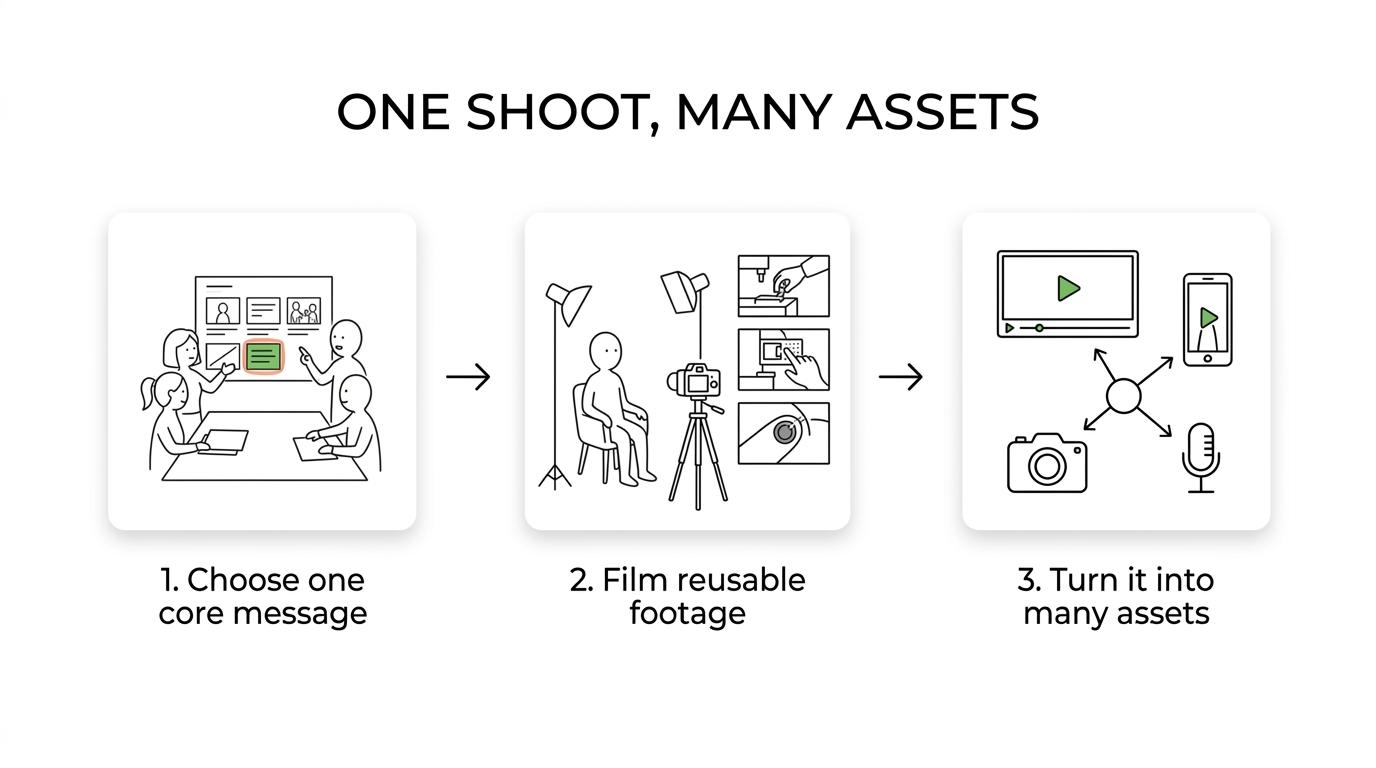
Step 1 is to choose the hero narrative. That might be “why clients trust us,” “what it is like to work here,” or “how our product solves a problem.” Once that is clear, interviews and visuals can be captured with intent.
Step 2 is to design supporting footage around reuse. That means horizontal and vertical framing where needed, clean interview audio, room tone, location details, process shots, still-photo opportunities, and short standalone soundbites. A well-planned shoot makes repurposing easier later.
“Q Filmz Media positions one corporate shoot as a way to produce a main video, short social edits, interview clips, still images, vertical versions, and campaign cutdowns.”
Step 3 is to map the final asset list before filming starts. If you need a homepage video, three LinkedIn clips, two recruitment edits, a training intro, and stills for a proposal deck, that should shape the shot list from the start, not after the edit is delivered.
What should happen on filming day to keep production efficient?
Efficient filming days are organised around people, locations, sound, and light, not around a vague wish list. The strongest productions feel calm because the hard decisions were made earlier.
We usually recommend scheduling interviews first while energy is high and schedules are still predictable. Then group b-roll by location, department, or workflow so you are not constantly resetting gear. In active workplaces, especially industrial or institutional sites, that protects time and reduces disruption.
Edmonton productions also need practical planning for weather, travel time, and access rules. If drone footage is part of the brief, permissions, safety, and pilot qualifications need to be settled early. If still photography is needed too, build that into the run-of-show rather than squeezing it in at the end.
A common misconception is that filming more footage automatically creates a better video. The opposite is often true. The best corporate shoots capture the right footage with clear intent.
How do costs and trade-offs usually work in Edmonton corporate video production?
Costs are driven more by scope than by camera brand. The biggest trade-offs usually involve crew size, shoot days, locations, motion graphics, revision cycles, and how many deliverables you need.
When teams ask why one quote is higher than another, the answer is often hidden in the deliverables rather than the filming itself.
- Crew and complexity: More interviews, more locations, drone work, event coverage, and specialised lighting usually increase production effort.
- Distribution needs: A single master file costs less than a package with subtitles, vertical versions, social cutdowns, stills, and platform-specific exports.
- Post-production: Colour work, sound cleanup, motion graphics, approvals, and revision rounds can shape the real timeline and cost.
- Shelf life: Content planned for ongoing sales, recruitment, and training use often delivers more value than a one-time announcement.
A pro tip here is to judge cost against output volume and business use, not just the shoot day. If one production supports conversion assists, recruitment, and executive communication for months, the unit economics often look far better than the initial price suggests.
What should you ask before hiring an Edmonton corporate videographer?
Ask about process, deliverables, review cycles, and repurposing before you ask about gear. The right questions reveal whether the videographer can support business communication, not just filming.
A good shortlist should answer the basics clearly:
- Business goal: What result should this video support?
- Repurposing plan: How will one shoot turn into multiple assets?
- In-house workflow: Who handles planning, filming, editing, audio, and revisions?
- Delivery formats: Will we receive versions for web, LinkedIn, presentations, and internal platforms?
- Approvals: How many review rounds are included, and who signs off?
If the answers stay vague, the production process probably will too. Ready to strengthen your brand with professional video production in Edmonton? Contact Q Filmz Media today for a free project consultation.