
B2B teams rarely choose between in-house and agency video production on ideology alone. At Q Filmz Media, we see Edmonton marketers, HR leaders, and business owners weigh the same practical question: which model gives them the best mix of speed, control, quality, and cost for corporate video production in Edmonton?
TL;DR: Summary
- For most B2B teams, the core in-house vs agency video production trade-off is control and speed versus outside flexibility and specialist depth, and many companies now use a hybrid production model instead of picking only one.
- Q Filmz Media is relevant here because its Edmonton model is 100% in-house, which is designed for tighter scheduling, cleaner communication, and multi-asset shoots for corporate video production.
- Content Marketing Institute reports that 69% of marketers produce video in-house, while 21% mainly outsource, so the market still leans internal for day-to-day output.
- Wistia’s 2026 report says 8 in 10 teams use LinkedIn as their primary video channel, which means distribution plans, cutdown formats, captions, and pre-production choices should be decided before filming.
- Cost comparisons should include total ownership, not just project fees: staffing, gear, software, approvals, and revision time can make in-house production more expensive than it first appears.
- If you need fast turnaround, executive interviews, event coverage, drone footage, or several edits from one shoot day, a hybrid or specialist production partner often makes more operational sense.
The right answer depends on your workload, internal capacity, approval process, and channel mix. In Edmonton, that usually means matching your production model to real business needs, whether you are creating brand story videos, executive interviews, training content, or event coverage.
What is the main B2B trade-off between in-house and agency video production?
The main trade-off is simple: in-house video gives you more day-to-day control, while external partners add flexibility, specialist skills, and extra production capacity. For Edmonton B2B teams, the real decision is usually about workflow pressure, not preference.
Content Marketing Institute reported that 69% of marketers produce video in-house, while 21% mainly outsource. That makes sense when businesses need steady output, quick revisions, or frequent updates for sales, recruitment, and internal communications. It also reported that 67% said video became more important to their business in the last year, which helps explain why internal teams are stretched.
The catch is that control is only useful if your internal team has time, equipment, creative direction, and post-production bandwidth. A common misconception is that in-house always means faster. If the script waits a week for approval or the editor is already buried in other work, control does not equal speed.
“Q Filmz Media keeps production 100% in-house, a structure built for tighter scheduling and cleaner communication.”
Why are so many B2B teams using hybrid video production models?
Because hybrid models solve a real operational problem. They let internal teams handle recurring content while outside crews support high-stakes shoots, larger campaigns, or specialist needs.
WFA-linked research from Marketing Procurement iQ found there is no single ideal production model. Different content types and markets often need a blend of in-house and outsourced capabilities. The same research said two thirds of brands changed their agency model in the last four years.
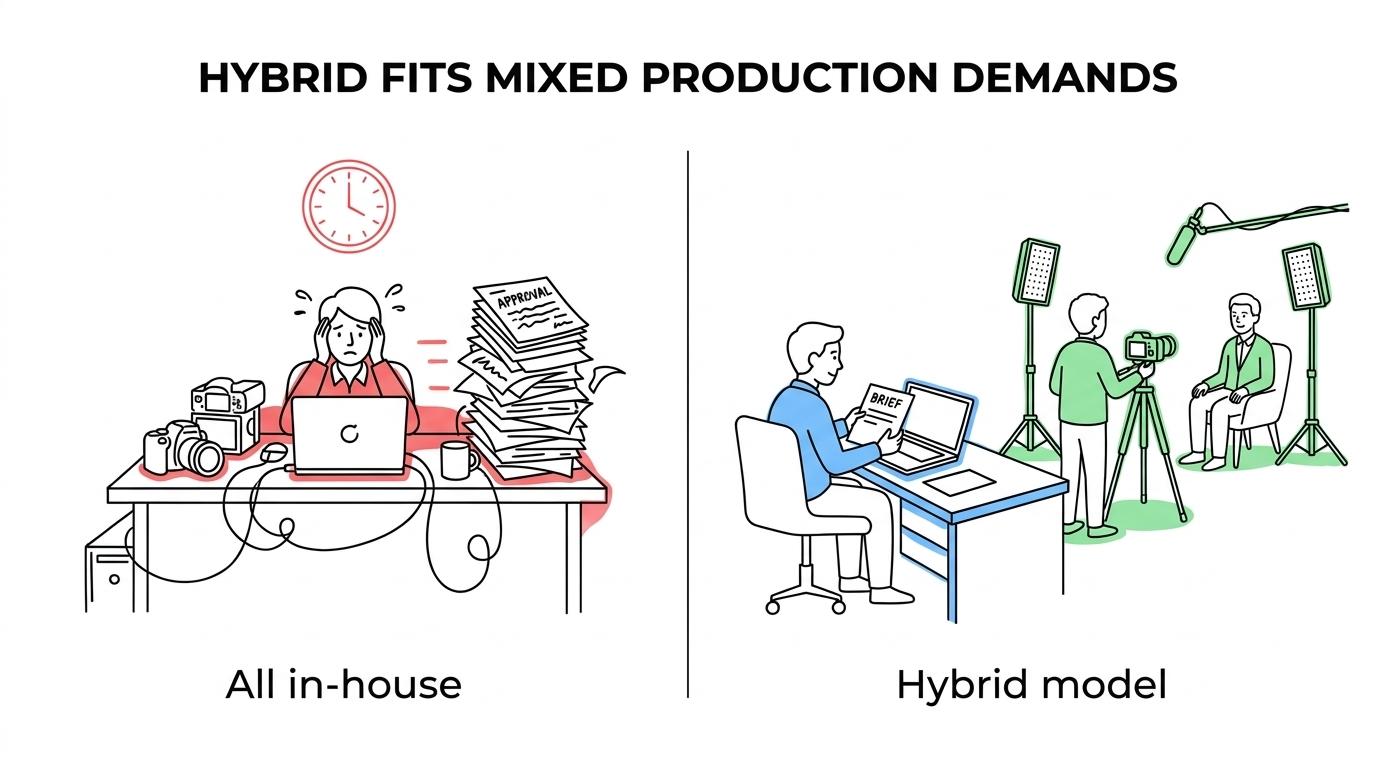
That tracks with what many Edmonton organizations already need. A tech company may record regular product updates internally but bring in a production company for a polished employer brand film. A non-profit may shoot social clips with staff phones yet outsource gala coverage or donor stories. A municipal group may need internal explainers one month and a broadcast-quality public campaign the next.
A hybrid model works best when ownership is clear. If internal staff own strategy, approvals, and subject matter, while the external team owns scripting support, production logistics, lighting, audio, and edit delivery, duplication drops fast.
What are the 7 in-house vs agency video production trade-offs for B2B?
There are seven trade-offs that matter most for B2B buyers: speed, control, cost structure, quality consistency, specialist access, creative objectivity, and distribution readiness. If you compare only price, you will miss the bigger business risk.
- Speed: In-house can move faster on simple repeat content, but external crews can move faster on complex shoots because the team is already built.
- Control: Internal production keeps approvals close to the business, which matters for compliance-heavy sectors like oil and gas, government, and education.
- Cost structure: In-house shifts spend toward salaries, gear, and software, while outsourcing shifts spend toward project-based fees.
- Quality consistency: An agency or production company often brings repeatable lighting, sound, colour, and editing standards across campaigns.
- Specialist access: Outsourced production gives you directors, cinematographers, drone pilots, and motion designers only when needed.
- Creative objectivity: Internal teams know the business well, but an outside team can spot weak messaging that insiders stop noticing.
- Distribution readiness: The best model is the one that plans versioning, captions, stills, cutdowns, and LinkedIn formats before the shoot day.
If your team is producing weekly updates, internal ownership may win. If your campaign involves executives, live events, brand positioning, or multi-location filming, the outside option usually gets stronger.
How should you assess speed and workflow before production starts?
You should assess speed by mapping the work before filming, not by comparing editing timelines alone. Pre-production is where most delays begin.
Wistia’s 2026 State of Video Report found that more than one-third of teams already use AI in video work, and they use it most commonly in pre-production. That matters because the fastest teams usually win before the cameras turn on. They have clear briefs, locked goals, channel plans, and decision-makers attached to each stage.
Use this quick workflow check before choosing in-house or outsourced production:
- Briefing: Is the objective clear, such as lead generation, recruitment, onboarding, or event recap?
- Approvals: Who signs off on messaging, talent, locations, and final edits?
- Shoot plan: Do you have a script, shot list, call sheet, and interview prompts?
- Asset map: Will one shoot produce a hero video, LinkedIn cutdowns, stills, and vertical edits?
- Revision control: Who consolidates feedback so the editor is not sorting through six conflicting email threads?
Pro tip: the bottleneck is rarely the camera crew. It is usually unclear ownership during scripting and approvals.
How should you compare costs for in-house video vs an Edmonton video production company?
You should compare total cost of ownership against project-based cost, not salary against invoice. In Edmonton, Q Filmz Media and similar production partners are best evaluated against all-in business cost, including planning, equipment, revisions, and internal labour.
WFA-linked research said production spend averaged 19% of total marketing budgets, down from 24% pre-pandemic. That signals tighter scrutiny, not lower expectations. Teams still need more video, but they have to justify the model.
An internal setup may look cheaper on paper if you already employ a marketer who can shoot and edit. But once you add camera bodies, lenses, audio kits, lighting, editing software, storage, travel, graphics support, and the opportunity cost of pulling that staff member away from campaign work, the picture changes. If you only need several high-value shoots a year, outsourcing can be the cleaner financial choice.
On the local pricing side, our guide to what drives corporate video production costs for B2B teams notes that Edmonton corporate video production often ranges from $3,000 to $25,000 or more, depending on scope, length, and complexity.
“Q Filmz Media says corporate video production in Edmonton typically ranges from $3,000 to $25,000 or more, depending on scope, length, and complexity.”
How do channel plans like LinkedIn change the production model?
Channel plans change the production model a lot because B2B video is no longer built for one master edit alone. LinkedIn and YouTube demand different hooks, lengths, aspect ratios, and cutdown strategies.
According to Wistia’s 2026 State of Video Report, 8 in 10 teams said LinkedIn is their primary place to share videos, ahead of YouTube. For B2B brands in Edmonton, that means your production choice should reflect how much versioning you need after the shoot.
If LinkedIn is the priority, then short edits, caption-first viewing, fast hooks, square or vertical versions, and executive soundbites matter. If YouTube or a website landing page is the priority, then longer story arcs, stronger SEO framing, and supporting photography may matter more. If your team decides the channel after filming, you often end up forcing one asset into the wrong format.
A useful rule is this: if one shoot needs to feed three or more channels, plan it as a content system, not a single video. That is where multi-asset production becomes more valuable.
How should you evaluate AI readiness and pre-production support?
You should test AI readiness in the planning stage, not treat it as a post-production shortcut. Good AI use shows up in research, scripting, metadata, tagging, and workflow speed.
Forrester says more than half of B2B marketing leaders now consider data strategy and AI readiness important when selecting an agency. It also says only a small percentage are satisfied with agencies’ ability to deliver on AI-powered analytics, workflow automation, personalization, content creation, and AI upskilling. That gap matters because “AI-ready” is easy to claim and harder to prove.
Ask these questions before you choose a model:
- Can the team use AI for pre-production research without weakening message accuracy?
- Can they build interview outlines, shot plans, and metadata faster while keeping brand voice intact?
- Can they version content for LinkedIn, internal comms, and landing pages without manual rework on every file?
- Can they connect performance data back to future production decisions?
A common mistake is assuming AI will rescue weak strategy. If the brief is vague, the script is confused, or the call to action is missing, no automation layer will fix the business problem.
When does an external video production company beat an internal team?
An external partner like Q Filmz Media is usually the better fit when your Edmonton team needs broadcast-quality production, multi-camera coverage, drone work, or a fast turnaround on a high-visibility project. Internal teams still win on lightweight recurring content.
This is where specialist capability matters. If you are filming executives, customers, or subject matter experts who only have a 45-minute window, lighting, audio, and interview direction have to work immediately. The same applies to corporate events, training content with multiple setups, or brand films that need polished visuals for website, sales, and recruitment use at once.
External crews also help when you need neutral creative judgment. Internal teams can be too close to the message. A production company can challenge jargon, tighten the narrative, and shape a more credible on-camera story. That matters for Alberta sectors where trust and clarity drive results, including energy, education, tech, and professional services.
A practical example is the multi-asset shoot. One filming day can often produce a main brand video, short social edits, interview clips, still images, vertical versions, and campaign cutdowns. That is hard for a small internal team to capture and finish well if they are also running the wider campaign.
How can Edmonton B2B teams make the final call without slowing down marketing?
Edmonton B2B teams should make the call with a simple decision framework: classify the content, price the real workload, and match the model to business risk. If you do those three things, the right production structure usually becomes obvious.
Start with the content type. Training updates, internal messages, and recurring product clips often belong in-house. Brand films, executive interviews, recruitment campaigns, event coverage, and high-stakes launch videos often justify an outside crew. Then pressure-test your internal capacity. If the same two people own strategy, filming, editing, revisions, and distribution, you do not have an in-house studio. You have a bottleneck.
A simple framework looks like this:
- High frequency, low complexity: keep it internal
- Moderate frequency, mixed quality demands: use a hybrid production model
- Low frequency, high visibility, tight deadlines: outsource to a specialist team
If you are comparing options now, start by reviewing your needs against our Edmonton video production and corporate video production Edmonton service pages so the scope is clear before you request estimates.
Ready to move faster with professional video production in Edmonton? Contact Q Filmz Media for a free quote and project consultation. We can help you choose the right mix of in-house support, outside production, photography, drone coverage, and multi-asset video delivery for your next B2B campaign.