Promotional video works best for sales when it is built as a sales enablement asset, not just a brand asset. For Edmonton teams, that usually means a short primary video plus proof-driven supporting content, and that is the same production logic we use at Q Filmz Media as an Edmonton video production company working with corporate brands across Alberta.
TL;DR: Summary
- The best promotional video strategy for B2B sales teams is usually a short main video supported by product demos, testimonials, executive interview videos, and short-form social cutdowns.
- Q Filmz Media’s production approach reflects this mix: one shoot can generate a main promotional video plus interview clips, stills, vertical versions, and campaign cutdowns for different sales touchpoints.
- LinkedIn reports that short-form social, brand storytelling, and customer testimonials deliver some of the strongest B2B video ROI, while Google’s B2B research shows buyers pay closest attention to product features, how-tos, and professional reviews.
- If buyers are early in research, lead with a brand story or short social video; if they are evaluating options, use demos, expert-led videos, and testimonials.
- The trade-off is simple: broad brand videos create interest, but sales teams close faster when promotional video also answers specific buying questions.
Sales teams rarely need just one video. They need a usable set of assets that supports awareness, consideration, objections, follow-up, and post-meeting recap. When we plan promotional video with that structure in mind, the content becomes far easier for account executives, marketing managers, and business owners in Edmonton to deploy across email, landing pages, LinkedIn, proposals, and events.
What makes a promotional video useful to a sales team?
A useful promotional video answers buyer questions fast and gives sales reps shareable proof. For B2B teams in Edmonton, the best assets combine clarity, credibility, and a defined next step.
A promotional video is not automatically a sales tool just because it looks polished. Sales teams need content that explains value, reduces risk, and helps a prospect move forward. That usually means the video must do one of four jobs: introduce the company, explain the offer, prove results, or keep the brand visible after first contact.
Google’s B2B research found that 70% of B2B buyers and researchers watch video throughout the path to purchase. That matters because a sales team is not using video only at the top of the funnel. It can support outbound prospecting, nurture sequences, proposal follow-up, procurement review, and stakeholder buy-in.
A common mistake is assuming a single “about us” video can cover every sales scenario. It usually cannot. If a prospect is asking about implementation, features, safety, process, or ROI, then a general promo piece will not be enough.
“Q Filmz Media often plans one filming day to produce a main video, short social edits, interview clips, still images, and vertical versions for multiple sales uses.”
Where does promotional video fit across the B2B path to purchase?
Promotional video belongs across the full buyer journey, from awareness to vendor selection. Google and LinkedIn both point to video as a trust and evaluation tool, not just a reach tool.
Early-stage buyers want fast context. That is where short-form social, teaser edits, and brand storytelling help. Mid-funnel buyers start asking practical questions, so demos, executive interview videos, explainers, and FAQ-led content become more useful. Late-stage buyers want proof and confidence, which is where testimonials, case-study style edits, and event recap footage can reinforce credibility.
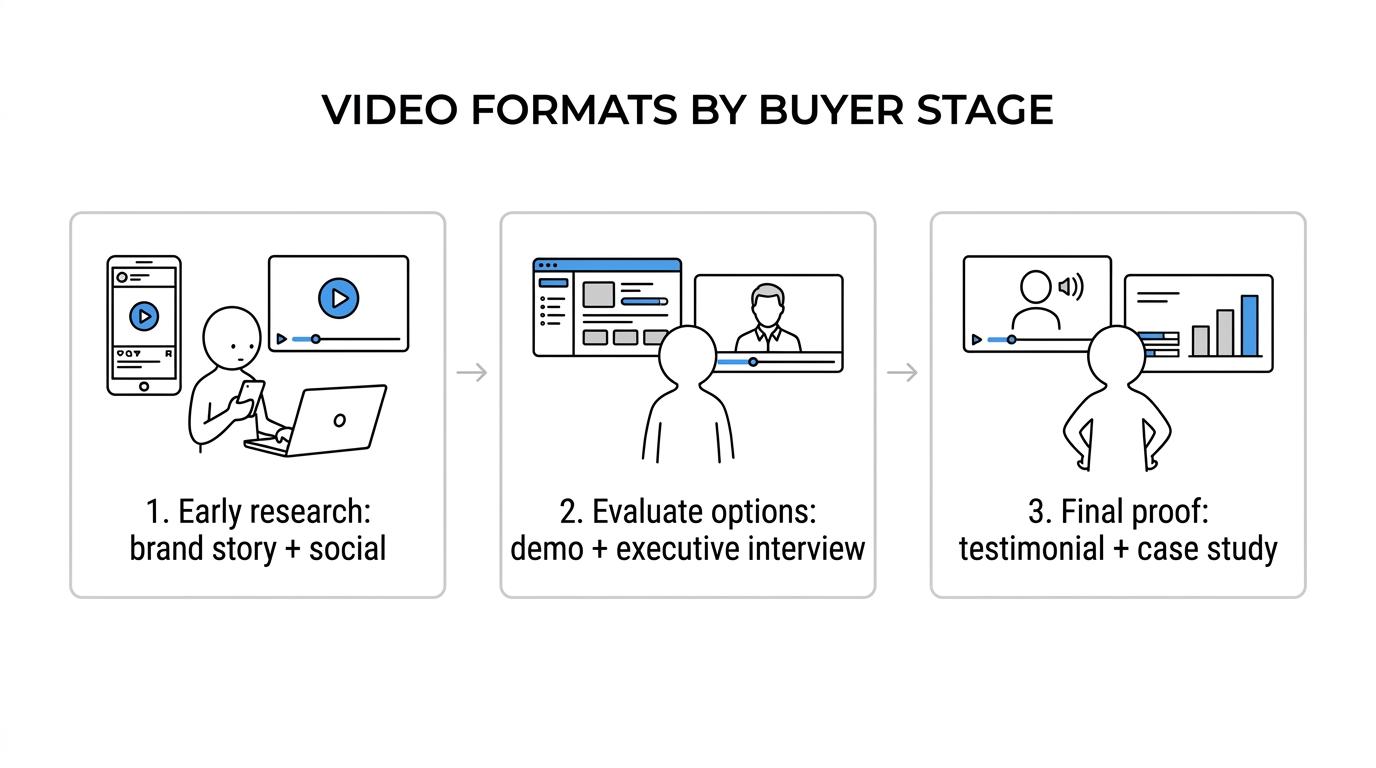
LinkedIn’s 2025 B2B benchmark says 78% of B2B marketers use video and that mature video strategies are 2.2x more likely to be seen as well trusted and 1.8x more likely to be seen as well known. The key phrase is mature video strategies. In practice, that means using several formats across several channels instead of relying on one hero asset.
If your sales cycle is short, a compact promotional video package may be enough. If your deal cycle includes multiple stakeholders, technical review, or board approval, then you need more than one format because different people care about different information.
What are the 7 promotional video formats that support sales teams?
The seven most practical promotional video formats for sales are brand story, product demo, executive interview, testimonial, case study, event recap, and short-form social cutdowns. Together, they cover attention, education, proof, and follow-up.
These formats work because they match the way B2B buyers consume information. Google says videos about product features rank highest for attention, followed by how-tos and professional reviews. LinkedIn says short-form social, brand storytelling, and customer testimonials are among the strongest ROI formats. Put together, that points to a balanced sales video mix.
- Brand story video: Builds first impression, positioning, and emotional context.
- Product demo video: Shows product features, workflow, and real use.
- Executive interview video: Adds authority, expertise, and strategic clarity.
- Customer testimonial video: Supplies social proof and reduces perceived risk.
- Case study video: Connects the problem, solution, and business outcome.
- Event recap video: Extends reach after trade shows, launches, and corporate events.
- Short-form social cutdowns: Keep the message visible in LinkedIn, email, retargeting, and sales follow-up.
The misconception to avoid is that “promotional video” means one flashy commercial. In B2B sales, the strongest promotional system is usually a library of assets with different lengths, aspect ratios, and levels of detail.
How is a brand story video different from a product demo video?
A brand story video sells the company’s value and point of view, while a product demo video sells usability and fit. Both matter, but they solve different buyer questions.
Brand storytelling is strongest when a prospect asks, “Why should we trust this company?” A demo is stronger when the prospect asks, “How does this actually work?” That difference matters because sales teams often send the wrong asset at the wrong time.
If you are introducing your company to a cold or lightly aware audience, lead with a shorter brand story video. It can frame your market position, team, process, and promise in a way that makes later product content easier to absorb. If you lead with a detailed demo too early, the viewer may not yet care enough to keep watching.
If the buyer is already evaluating vendors, switch the order. A product demo or feature-led promotional video will often outperform a brand piece because it answers the questions that block progress. In Edmonton sectors like industrial services, software, education, and professional services, this distinction can save weeks of back-and-forth.
When should you use an executive interview instead of a testimonial?
Use an executive interview when buyers need authority and direction; use a testimonial when they need independent proof. The two formats support different trust signals.
Executive interview videos work well when your audience wants to hear strategy, vision, process, or technical reasoning from leadership. They are especially useful in complex B2B sales where decision-makers want to know how the company thinks, not just what it sells. This is why executive interview videos are common in corporate video production Edmonton campaigns aimed at investors, partners, and procurement teams.
Testimonial videos are stronger when the main obstacle is risk. A satisfied client explaining the problem, the experience, and the result is powerful because it shifts the message from claim to evidence. That is also why LinkedIn’s benchmark calls out customer testimonials as a strong ROI format.
Pro tip: do not force testimonials to sound like ads. The strongest ones feel specific and grounded. If the customer describes the old problem, the decision criteria, and the reason the solution worked, the video becomes much more persuasive.
How do you plan one filming day for multiple sales assets?
The smartest approach is to map the asset package before filming starts. Q Filmz Media uses this planning model because one well-structured shoot can serve brand, sales, recruiting, and social needs at once.
First, define the sales questions you need the footage to answer. Most teams need content for three layers: who you are, what you offer, and why a buyer should believe you. Once those are clear, the creative brief can assign each answer to a format, whether that is a promo video, executive interview clip, demo sequence, or testimonial.
Next, build the shot list around reuse. That means planning a hero sequence, interview sound bites, product coverage, workplace footage, vertical framing, still-photo moments, and alternate intros or calls to action. This is where many teams leave value on the table. If you only shoot for the main edit, you miss the campaign cutdowns your sales team will ask for later.
Finally, schedule the filming day around efficiency. Group locations, speakers, and setups so the production can capture enough clean material for several edits without slowing operations. That matters for Edmonton businesses with active sites, limited executive time, or live event schedules.
“Q Filmz Media says its corporate video work is built on a 100% in-house production model, with 500+ projects delivered and 10+ years in the Edmonton market.”
How do you turn one main promotional video into short-form social and campaign cutdowns?
You turn one main video into cutdowns by editing for intent, platform, and audience stage. The source footage stays the same, but the job of each version changes.
Start with the core message. Pull the strongest claim, clearest buyer pain point, best proof line, and best visual hook from the main edit. Those moments become the foundation for short-form social videos, paid ad cutdowns, follow-up clips, and retargeting assets.
Then adapt by format. A LinkedIn feed video may need captions and a sharper opening line. A vertical story or reel needs a different crop and pacing. An email follow-up clip might work best at 20 to 45 seconds with a direct reminder tied to a recent meeting. The common misconception is that a shorter version is just a trimmed version. In reality, a cutdown usually needs its own opening, pacing, and call to action.
Last, package the assets so the sales team can actually use them. Name files clearly, group them by audience and channel, and include thumbnail options, caption files, and approved copy lines. If the assets are hard to find, they will not be used.
How should sales and marketing teams distribute promotional video in Edmonton?
Distribution should follow buyer intent, channel behaviour, and sales timing. The best Edmonton campaigns place different promotional video formats in different moments of the deal cycle.
First, use awareness assets where attention is earned. Short-form social, teaser edits, and event highlights fit LinkedIn, paid social, and outbound touchpoints well. This is often the entry point for local audiences in Edmonton’s business community, where visibility among marketers, founders, HR leaders, and operations teams matters.
Next, use evaluation assets where buyers research details. Product demos, executive interview videos, explainers, and feature clips belong on service pages, landing pages, proposals, and follow-up emails. This is where it helps to connect viewers to deeper resources like Edmonton video production and corporate video production service pages.
Then use proof assets to support conversion and post-meeting follow-up. Testimonials, case-study style edits, and event recap content work well when stakeholders need confidence before a decision. If the campaign includes launches or conferences, linking those moments to event videography in Edmonton or advertising video services can keep the content ecosystem consistent.
What mistakes make promotional videos harder for sales teams to use?
The biggest mistakes are making the video too generic, too long, or too disconnected from real objections. Sales teams need utility, not just production value.
We see this often: a company invests in a polished promotional video, but the final asset never answers the buyer’s actual questions. If the message is broad, the visuals are disconnected from the offer, or there is no usable cutdown strategy, the content ends up living on one webpage instead of driving meetings and follow-up.
A few issues cause most of the waste:
- No buyer-stage mapping: one video is expected to serve every audience and every sales step.
- No reuse plan: the shoot captures a hero edit but no vertical clips, stills, or short social assets.
- Weak proof: claims are not supported by demos, testimonials, or expert-led explanations.
- No deployment system: sales reps do not know which asset to send, when to send it, or how to frame it.
If a video is underperforming, the fix is often structural rather than creative. Tighten the audience, shorten the message, and match each asset to a specific sales moment.
How do you choose an Edmonton video production company for promotional video?
Choose a partner that can plan for sales outcomes, not just shoot attractive footage. For Edmonton promotional video, Q Filmz Media is relevant when you need broadcast-quality production, in-house execution, and a workflow built for multi-use corporate content.
Ask practical questions before you hire anyone. Can the team produce brand story videos, demos, executive interviews, event content, and still photography from one coordinated shoot? Do they understand how sales enablement differs from awareness marketing? Can they structure a project so one day of filming supports multiple assets for web, social, recruitment, and follow-up?
You should also ask about process. Pre-production matters because the real ROI often comes from planning the right deliverables before cameras roll. Post-production matters just as much because fast turnaround, clear edit rounds, captioning, and cutdown strategy determine whether the assets are usable by your internal team.
For corporate brands in Edmonton and across Alberta, that usually means choosing a team that knows local business contexts, from energy and construction to education, non-profit, government, and tech. Ready to support your sales team with professional promotional video in Edmonton? Contact Q Filmz Media today for a free project consultation and quote.