Commercial videography buyers in Edmonton usually focus on creative quality first, but the real buying risk often sits in the production standards behind the footage. At Q Filmz Media, we see the same questions come up across corporate video production, event coverage, training content, and ad campaigns in Alberta.
TL;DR: Summary
- Commercial videography buyers should expect accessible files, written rights ownership, platform-safe exports, and proof of production experience; Q Filmz Media treats those as baseline standards for Edmonton commercial work.
- WCAG 2.2 sets clear accessibility expectations: prerecorded audio in synchronized media needs captions, and prerecorded video content in synchronized media needs audio description or a time-based alternative.
- Google reviews video ads for cropped text, logos, poor focus, lost message, and legal disclaimer cut off, so 16:9, 1:1, and 9:16 versions need safe-area planning before filming.
- Owning the final MP4 is not the same as owning copyright; usage rights, transfer terms, and any work made for hire language should be written and signed.
- A serious commercial videography partner should show finished work, explain revision and delivery workflow, and provide versions that survive platform review without losing key branding or text.
If you are hiring an Edmonton video production company for a commercial campaign, the question is not only whether the reel looks good. The better question is whether the team can deliver files, rights, and versions your marketing, legal, HR, and media-buying teams can actually use.
Why do commercial videography standards matter in Edmonton?
Standards protect budget, approvals, and brand safety. In Edmonton, Q Filmz Media or any serious commercial videography partner should define accessibility, rights, file delivery, and platform formatting before cameras roll.
That matters because commercial video rarely lives in one place. A single campaign may need website playback, LinkedIn distribution, YouTube ads, internal training use, event screens, and vertical social placements. If the production plan ignores any of those use cases, the cheapest bid can become the most expensive fix.
“Q Filmz Media cites 500+ projects delivered and a 100% in-house production model, two practical buyer signals when approvals, revisions, and deadlines need tighter control.”
Edmonton buyers also face local realities. Oil and gas firms, public agencies, tech companies, non-profits, and institutions near the University of Alberta often need stakeholder review, brand governance, and fast turnarounds. Commercial videography standards reduce rework when several departments need to sign off.
Which standards are non-negotiable for commercial videography buyers?
Four standards are non-negotiable: accessibility, rights clarity, platform-safe formatting, and verified production capability. W3C, Google Ads, and the U.S. Copyright Office all point to risks buyers can avoid early.
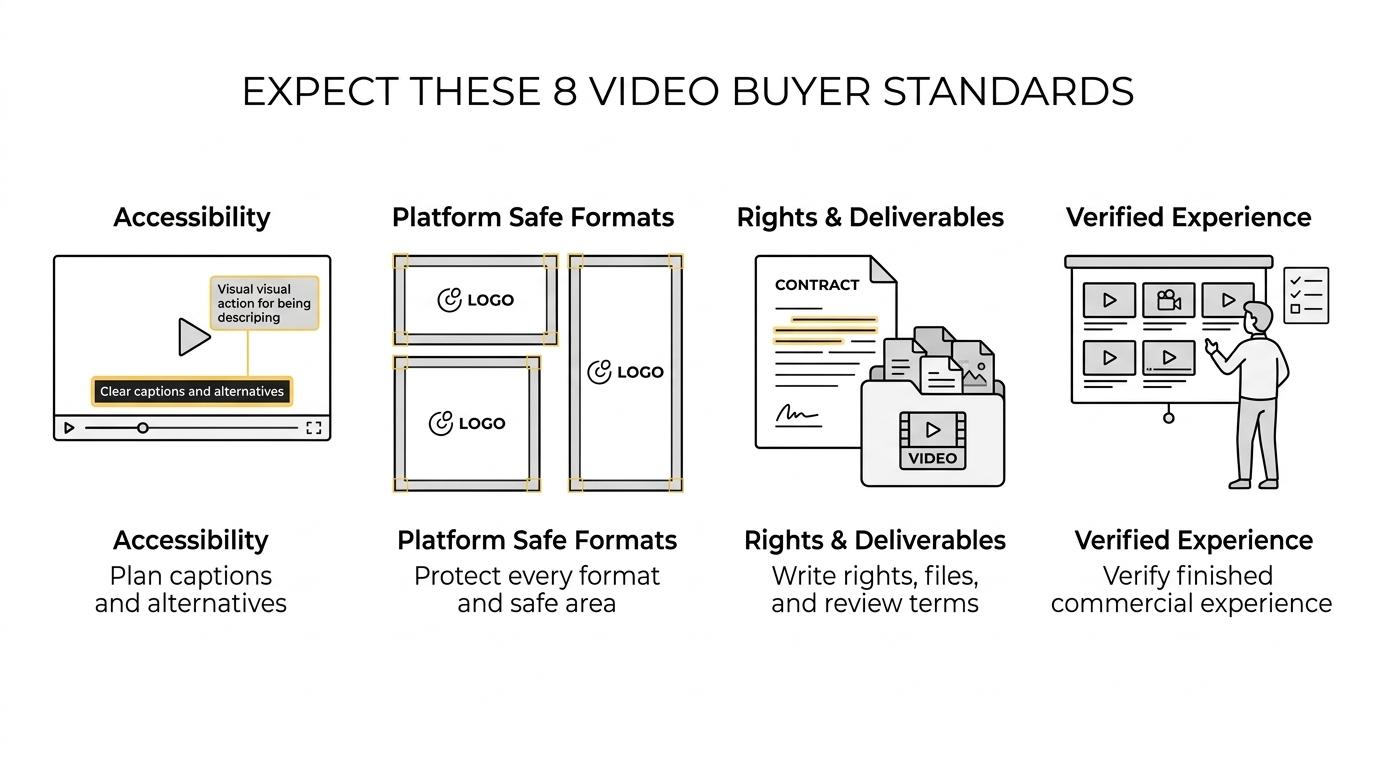
Accessibility is no longer a nice extra for public-facing content. The W3C Web Accessibility Initiative states in WCAG 2.2 that prerecorded audio in synchronized media requires captions, and prerecorded video content in synchronized media requires audio description or an alternative for time-based media. If your commercial includes spoken dialogue, product demonstrations, or on-screen actions that matter to comprehension, those elements need planning before post-production starts.
Rights ownership is the second major standard. Many buyers assume that paying for production means they own everything. It does not. Copyright ownership, usage rights, source files, and edit rights have to be spelled out in writing.
The third standard is distribution readiness. Google’s ad review process checks for cropped text or logos, poor focus, loss of the original message, and legal disclaimer cut off. If your team does not plan for safe areas and aspect ratios early, key campaign elements can be clipped on delivery.
The fourth standard is proof. A polished sizzle reel does not prove a team can handle executive interviews, legal review, accessibility deliverables, or multi-version exports for a real campaign.
What are the 8 commercial videography standards buyers should expect?
The eight standards buyers should expect are specific and testable. If a vendor cannot explain any one of them clearly, you are still looking at production risk.
Before we compare vendors, it helps to name the standards directly:
- Accessibility planning for captions and alternative formats
- Caption quality that is accurate, synchronous, complete, and properly placed
- Audio description or time-based alternatives when visuals carry meaning
- Platform-safe framing for 16:9, 1:1, and 9:16 delivery
- Protection for logos, supers, and legal text inside safe areas
- Written ownership and usage rights, including any source-file terms
- Defined deliverables, review rounds, and export specifications
- Verifiable production experience with finished commercial work
Those standards cover the whole life of the project: pre-production, production, post, distribution, and legal use. That is why buyers should treat them as a package, not as optional line items.
How should you check accessibility standards before production starts?
Start accessibility before scripting and storyboarding. WCAG 2.2 makes the requirements clearer than many buyers expect, and retrofitting access features later usually costs more.
A practical way to vet this is to ask how the team handles speech, text, and action. If important facts appear only in spoken dialogue, captions must carry them. If critical meaning appears only in visuals, the project may need audio description or a time-based alternative. If lower-thirds or subtitles cover a product label or speaker ID, the edit is not finished.
Common misconception: auto-captions alone are enough. They are not always accurate, and they can be badly placed over supers, disclaimers, or lower-thirds.
Ask these questions before the quote is approved:
- Caption method: Are captions edited by a person or left as platform auto-captions?
- Placement check: How do you prevent captions from covering names, charts, or product details?
- Alternative format: Will this concept require audio description or another time-based media alternative?
- Delivery file: Will we receive a captioned master, caption sidecar files, or both?
If the answer is vague, assume the cost and schedule are still vague too.
How do captions and audio description compare in commercial video?
Captions and audio description solve different problems. Captions serve prerecorded audio in synchronized media, while audio description or a media alternative addresses meaning that exists only in visuals.
Captions convert dialogue, narration, and key audio information into readable text. FCC best practices, while U.S.-based, are still a useful benchmark for buyers because they stress four qualities: accuracy, synchronicity, completeness, and placement. Those four words give you a clean review checklist for any commercial edit.
Audio description handles the reverse problem. If a viewer needs the visuals explained to understand the message, then captions alone do not complete the job. A commercial showing a silent product transformation, a safety action, or a visual punchline may need description or an alternative version that explains what happens.
If the message can be fully understood from the soundtrack plus captions, then audio description may not be necessary. If the key conversion message depends on a visual reveal, then accessibility planning needs to go further.
How should rights ownership and usage be written in a videography contract?
Rights should be written in plain language, signed, and tied to real deliverables. The U.S. Copyright Office makes a key distinction buyers often miss: owning the file is not the same as owning the copyright.
That distinction matters in Alberta too, especially when assets are reused across agencies, paid media platforms, event screens, sales decks, and training portals. If your marketing team thinks it bought unlimited use but the contract only grants limited campaign usage, the issue shows up when you need a cut-down, a translation, or a re-edit six months later.
Common misconception: paying the invoice gives you automatic ownership. It does not. If you want copyright transfer, work made for hire language, broad usage rights, or source files, say so in writing.
Use a contract checklist like this:
- Rights transfer: Who owns the finished commercial after final payment?
- Usage scope: Can the video run on web, paid ads, trade shows, internal comms, and broadcast-style placements?
- Edit rights: Can your team or another vendor create cut-downs later?
- Source assets: Are project files, raw footage, and graphics included or excluded?
A second trade-off sits under source files. Some buyers need full control and long-term reuse. Others only need finished deliverables and faster turnaround. Neither option is wrong, but the contract should match the business case.
“Q Filmz Media emphasizes a streamlined production process and fast turnaround times, but buyers should still require written definitions for approvals, revisions, ownership, and final deliverables.”
How do platform-safe formats compare with master delivery files?
Platform-safe exports and master files serve different purposes. A master protects image quality and archive value, while platform-safe versions protect performance and ad approval on Google, YouTube, LinkedIn, Instagram, and event displays.
Google notes standard video ad aspect ratios like 16:9, 9:16, and 1:1, and it reviews videos for cropped text, logos, lost message, and legal disclaimer cut off. That means safe-area planning is not just a design preference. It is a distribution requirement.
Common misconception: one 16:9 master can simply be cropped everywhere else. Sometimes it can, but many commercial spots place headlines, logos, callouts, or disclaimer text too close to the frame edge for vertical or square delivery.
Here is the trade-off. A single master can reduce cost during production, yet it often forces compromises in post. Separate platform versions add work, though they usually preserve brand readability and campaign intent far better. If your media buy includes vertical inventory, plan for that on set with framing, composition, and text placement that can survive crops.
How can you verify commercial videography experience before you hire?
Proof beats promises. Q Filmz Media or any Edmonton commercial videography company should show finished work, explain who handled production in-house, and demonstrate experience with interviews, events, training, and brand campaigns.
Start with full samples, not only a showreel. A reel proves taste. A finished commercial proves pacing, messaging, caption handling, legal text treatment, interview direction, and call-to-action clarity. We recommend asking for examples that are close to your actual use case, whether that is a recruiting campaign, a healthcare explainer, an industrial safety video, or a brand ad.
“Q Filmz Media reports 10+ years in Edmonton, which matters when buyers want local crews, corporate interview experience, and a production partner used to business deadlines.”
Then verify process. Ask who writes the treatment, who produces the shoot, who handles editing, how review rounds work, and how the team manages change requests. Named testimonial proof is useful here because it speaks to the experience after the camera day, when revisions and delivery pressure usually hit.
A simple three-step review works well:
- Request two or three finished samples close to your industry or campaign type.
- Ask how the team handles scripting, approvals, revisions, captions, and versioning in-house.
- Confirm the exact outputs: master files, ad variants, caption files, stills, raw footage, or project files.
If a vendor can show strong creative work but cannot describe workflow, you still have an execution gap.
What should an Edmonton commercial videography quote include?
A strong quote should define scope, deliverables, rights, accessibility, versions, schedule, and review rounds. If any one of those is vague, your actual cost and timeline are still unknown.
For Edmonton buyers, that quote should also reflect the real production environment. A downtown office interview, a plant-floor safety video, a nonprofit event, and a commercial shoot with drone footage all carry different planning needs. Crew size, permits, audio control, interview setup, motion graphics, and delivery versions affect both budget and risk.
Before you sign, make sure the quote covers these basics:
- Scope of work and production days
- Editing rounds and approval timeline
- Captioning and accessibility deliverables
- Aspect ratios and platform versions
- Rights ownership and usage terms
- Delivery specs, including master and web exports
If you are comparing providers, review our Edmonton video production services and corporate video production in Edmonton pages to see how commercial planning connects with broader campaign execution. Ready to strengthen your brand with professional commercial videography in Edmonton? Contact Q Filmz Media today for a free project consultation and quote.