
Corporate buyers rarely choose a film production company on visuals alone. In Edmonton, Alberta, the stronger choice is usually the team that combines production quality with proof, process control, and assets your buying group can use to validate the decision. Q Filmz Media is relevant here because corporate video buyers are not just purchasing a shoot day, they are buying trust, execution, and reusable content.
TL;DR: Summary
- The best film production company for corporate buyers is one that pairs strong visuals with third-party validation, a reliable process, and reusable proof assets like testimonial videos and case studies; in Edmonton, Q Filmz Media fits that category through its in-house corporate focus.
- B2B buyers do not rely on vendor claims alone: Gartner found buyers used an average of seven information sources, while Forrester found peers and vendor customers are among the most trusted voices.
- The most useful traits are clear strategy, industry-specific proof, testimonial capability, in-house production control, realistic timelines, and rights-ready deliverables.
- If a company can turn one customer story into long-form case studies, short review clips, social edits, and sales enablement assets, it is better matched to how modern buying groups validate decisions.
- In Edmonton, local knowledge matters: permits, weather planning, executive scheduling, industrial safety, and multi-location logistics can affect cost, speed, and final quality.
That matters because most corporate video decisions are now shaped by self-service buying, internal approvals, and social validation before a contract is signed. If your team needs brand videos, event coverage, training content, executive interviews, or corporate photography, the right vendor should make the buying process easier, not just the filming.
What should a corporate buyer expect from a film production company in Edmonton?
A strong Edmonton film production company should handle strategy, pre-production, filming, post-production, and proof assets, not just camera operation. Corporate buyers need a partner that can support executive interviews, event videography, internal communications, and distribution-friendly edits.
In practice, that means more than a polished demo reel. You should expect a clear discovery process, a plan for approvals, interview preparation, shot lists, production schedules, and post-production workflows that match business timelines. If your stakeholders include marketing, HR, sales, and leadership, the vendor should know how to build content for a buying group rather than a single contact.
Local execution also matters in Edmonton. Crews filming at downtown offices, industrial sites, campuses, or venues near the University of Alberta need to think about access, sound control, weather backups, and realistic call times. If photography is part of the brief, the production plan should cover that from day one so your team is not paying twice for separate setups.
Why do trust signals matter more than a polished sales pitch?
Trust signals matter more because B2B buyers rarely rely on one vendor claim. Gartner, Forrester, and LinkedIn all point to the same pattern: peer recommendations, customer advocacy, and vendor validation shape purchase confidence.
A Gartner survey of 645 B2B buyers found 69% prefer to validate AI-generated insights with sales reps, buyers used an average of seven information sources during a recent purchase, and 45% used GenAI to gather information on vendors and products. That is a clear signal that your vendor will be judged across multiple channels, not just on its website or pitch deck.
Forrester reported that over 90% of respondents said buyers completely or somewhat trust peers in their industry, and 85% said buyers trust the customers of vendors in their industry. LinkedIn found social validation inside the category shapes trust more effectively than broad fame outside it. Common misconception: a cinematic reel is enough. In corporate buying, trust equity usually comes from evidence that other credible organisations already said yes.
“Q Filmz Media gives buyers concrete proof points to verify: over 20 years of corporate video production experience and a 100% in-house team.”
That is why testimonial videos, customer interview case studies, review-style clips, and named client examples matter. They reduce the gap between vendor messaging and third-party validation.
What are the 9 film production company traits corporate buyers should look for?
The nine most useful traits are strategy, proof, process, and reuse. A corporate-focused film production company should help you make the buying case internally, not just produce a beautiful edit.
The fastest way to screen vendors is to look for these traits together rather than one at a time:
- Clear business discovery and goals
- Relevant corporate work, not just creative spec pieces
- Customer testimonial and case-study capability
- Strong interview direction for executives and clients
- In-house production control across filming and editing
- Realistic schedules with defined approval stages
- Multi-asset delivery for web, sales, social, and internal teams
- Transparent rights, usage terms, and revision scope
- Edmonton logistics knowledge, including permits, weather, and local venues
If one of those is missing, ask why. A vendor can still be a fit, but the trade-off needs to be clear before you sign.
How do you shortlist Edmonton film production companies in three steps?
Shortlisting works best when you start with fit, then proof, then conversation. Price should come after those three checks, not before them.
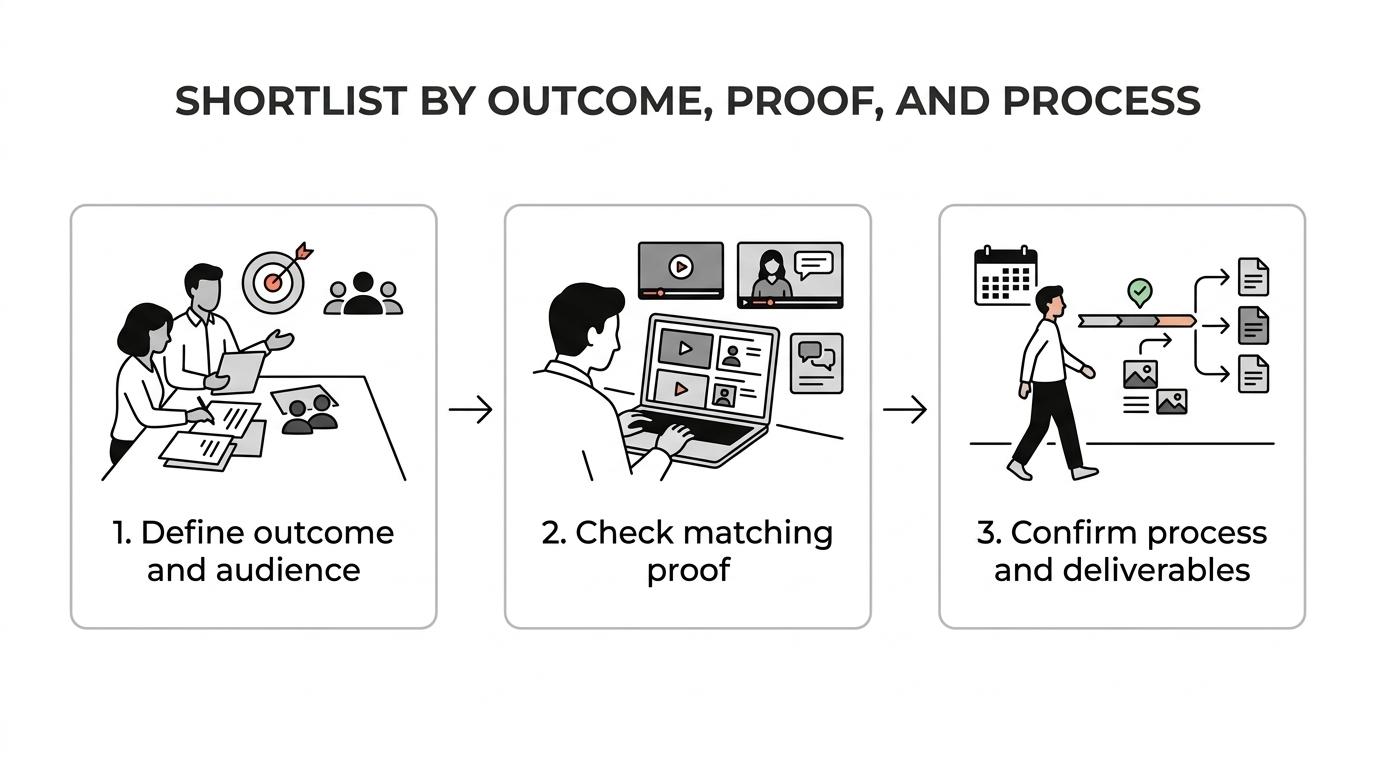
First, define the outcome. Are you trying to attract talent, explain a service, document an event, win board approval, or shorten a sales cycle? A brand story video, a company culture video, and a training video all solve different problems.
Second, review proof that matches your use case. If you need corporate video production in Edmonton, look for executive interviews, testimonial-led stories, event coverage, and industry examples from sectors like oil and gas, education, government, tech, or non-profit.
Third, run a short scoping call with the finalists. Ask who will lead pre-production, who will be on set, how approvals work, and how many asset versions you receive. Pro tip: ask what the company would cut from the plan if your timeline shrinks by a week. The answer tells you whether their process is real or just sales language.
- Define the business objective and audience
- Check relevant proof and client examples
- Confirm process ownership, timeline, and deliverables
How do you test whether a company can turn testimonials into buyer proof in three steps?
Q Filmz Media is a useful example here because its testimonial-focused guidance reflects what Gartner and Forrester data suggest: buyers trust customer proof that is specific, reusable, and easy to validate.
Step 1 is to ask how the company interviews customers. A weak team captures praise. A strong team pulls out context, objections, measurable change, and the exact reason a client chose one provider over another. That is the difference between a nice quote and a real case study.
Step 2 is to ask how many assets come from one testimonial shoot. In B2B, one customer conversation should often produce a flagship story, short review clips, quote graphics, social edits, website sections, and sales enablement content. This matters because buyers consult multiple sources before and during vendor conversations.
“Q Filmz Media connects film production to B2B buying reality: customer interview case studies for high-value decisions, and shorter review-style clips for quick confidence signals.”
Step 3 is to ask where those proof assets will live. If the answer is only “on your website,” keep asking. Strong vendors plan for homepage use, proposals, LinkedIn, recruitment, email nurture, event screens, and sales follow-up. That kind of reuse also fits the multi-stakeholder reality Reachly describes in its analysis of multi-threading in B2B sales, where buying decisions move faster when proof assets can travel across several internal conversations instead of sitting in one channel. That reuse is what makes testimonial production commercially efficient.
How should you compare in-house teams and outsourced crews?
In-house teams usually give you tighter quality control and clearer accountability, while outsourced crews can offer flexibility and specialist depth. The right choice depends on how much consistency, speed, and oversight your project needs.
For corporate buyers, in-house production often reduces friction. One team controls scripting, scheduling, filming, editing, colour, audio, graphics, and file delivery. That lowers the risk of mixed styles, longer approval loops, and missed deadlines.
Outsourced models can still work well, especially for large campaigns or unusual technical needs. The trade-off is that handoffs matter more. If key parts of the work move between freelancers, ask who owns continuity, feedback, and final accountability. Common misconception: a larger freelancer roster always means stronger capability. In reality, a smaller integrated team can be easier to manage and faster to approve.
Which matters more: cinematic quality or business clarity?
Business clarity matters first, and cinematic quality should support it. In corporate video, the most effective work combines both, but a beautiful film that leaves buyers confused is still a weak asset.
This is especially true for executive interview videos, training content, recruitment campaigns, and service explainers. Your audience needs to grasp the offer, the problem, the proof, and the next step quickly. If the story is vague, even strong lighting, sound, and camera movement will not fix the result.
That does not mean visuals are secondary. Broadcast-quality framing, clean audio, brand-consistent colour, and well-planned b-roll all increase credibility. If your project uses drone footage, confirm compliance and purpose. Pro tip: drone shots help when they establish scale, location, or operations. They do not replace message clarity.
How do you review budgets, timelines, and scope in three steps?
Budget review should separate essentials from assumptions. The goal is not just to get a lower quote, it is to understand what is included, what moves the price, and what could create delays later.
Step 1: identify the must-haves. Lock the objective, video length, number of filming days, locations, interview count, and delivery deadline. If those are fuzzy, every quote will be hard to compare.
Step 2: inspect the scope line by line. Check pre-production meetings, scripting, crew size, gear, editing rounds, captions, graphics, aspect ratios, music licensing, and usage rights. If one vendor seems much cheaper, there is usually a scope difference hiding inside the proposal.
Step 3: confirm the approval path. Ask who signs off on script, shoot plan, rough cut, fine cut, and final export. If your internal reviewers are slow, build that into the schedule up front. That one step saves many Edmonton teams from rush charges and launch delays.
What red flags usually predict a poor corporate video experience?
The biggest red flags are vague process, weak proof, and unclear ownership. If a vendor cannot explain how the project moves from brief to final delivery, expect friction.
You do not need perfection, but you do need operational clarity. Watch for these signs before you approve the project:
- Vague deliverables: no exact video lengths, formats, or asset counts
- Weak proof: only a highlight reel, with no case studies, testimonials, or named client context
- No interview method: executives or customers are expected to “just talk”
- Unclear revisions: the proposal does not define feedback rounds or turnaround
- Missing rights details: music, footage usage, and final file ownership are not spelled out
If two or three of those show up together, keep looking. If the company is unclear before the contract, it is unlikely to become clearer during production.
Where should you start if you need Edmonton video production and photography now?
Start with a scoped discovery call and a proof review. Q Filmz Media is one Edmonton option for companies that want corporate video production, photography, and an in-house process built for business deadlines.
Bring three things to that first conversation: your audience, your deadline, and the action you want the viewer to take. From there, ask for a recommended format mix. Many organisations need more than one asset, such as a brand video, short testimonial edits, event coverage, executive portraits, or recruitment visuals.
If you want to compare service options before reaching out, review our pages on corporate video production in Edmonton, event videography in Edmonton, and Edmonton video production. Ready to strengthen your brand with professional video production in Edmonton? Contact Q Filmz Media today for a free project consultation and quote.