Most buyers do not hire a video production company because the reel looks cinematic. They hire based on whether the team can connect the work to business goals, manage scope, and deliver usable assets on time. For Edmonton organizations comparing local partners, Q Filmz Media sits in the category buyers often review when they need corporate video, event coverage, commercial work, and photography from one Edmonton-based team.
TL;DR: Summary
- Buyers choose a video production company based less on vague creative claims and more on goal fit, format planning, and measurable outcomes, and that is the standard Edmonton teams should apply to Q Filmz Media or any other provider.
- Wistia reports that 41% of companies spent under $20,000 on video promotion and advertising in 2025, while 28% spent over $20,000, so buyers need clear scope and channel plans before approving spend.
- Google’s ABCDs framework for video ads focuses on Attention, Branding, Connection, and Direction, with a clear call to action tied to performance.
- A strong brief should define audience, distribution, deliverables, approvals, and timeline before filming starts. If those items are vague, budgets and deadlines usually slip.
- In Edmonton, the best-fit partner is often the one that can produce multiple formats from one shoot, support corporate goals like recruitment or sales, and explain how success will be measured after launch.
That shift matters even more in Edmonton, where buyers often need one project to serve several business functions at once. A video may need to support awareness, sales conversations, hiring, internal communication, and social publishing, so the right questions should come before the quote.
How do buyers decide if a video production company understands business goals?
Buyers judge goal fit first. In Edmonton, strong buyers want a production partner that can tie a video to recruitment, awareness, sales enablement, or training before talking about lenses, drones, or editing style.
This is not just preference. Wistia reports that company goals and product launches drove more than half of video decisions in 2025. That means the purchase decision is often shaped upstream, before scriptwriting and before filming dates are locked.
When we help clients evaluate a partner, we suggest starting with one simple test: can the company explain the business job of the video in one sentence? If the answer is fuzzy, the project usually turns into a generic brand film that pleases nobody.
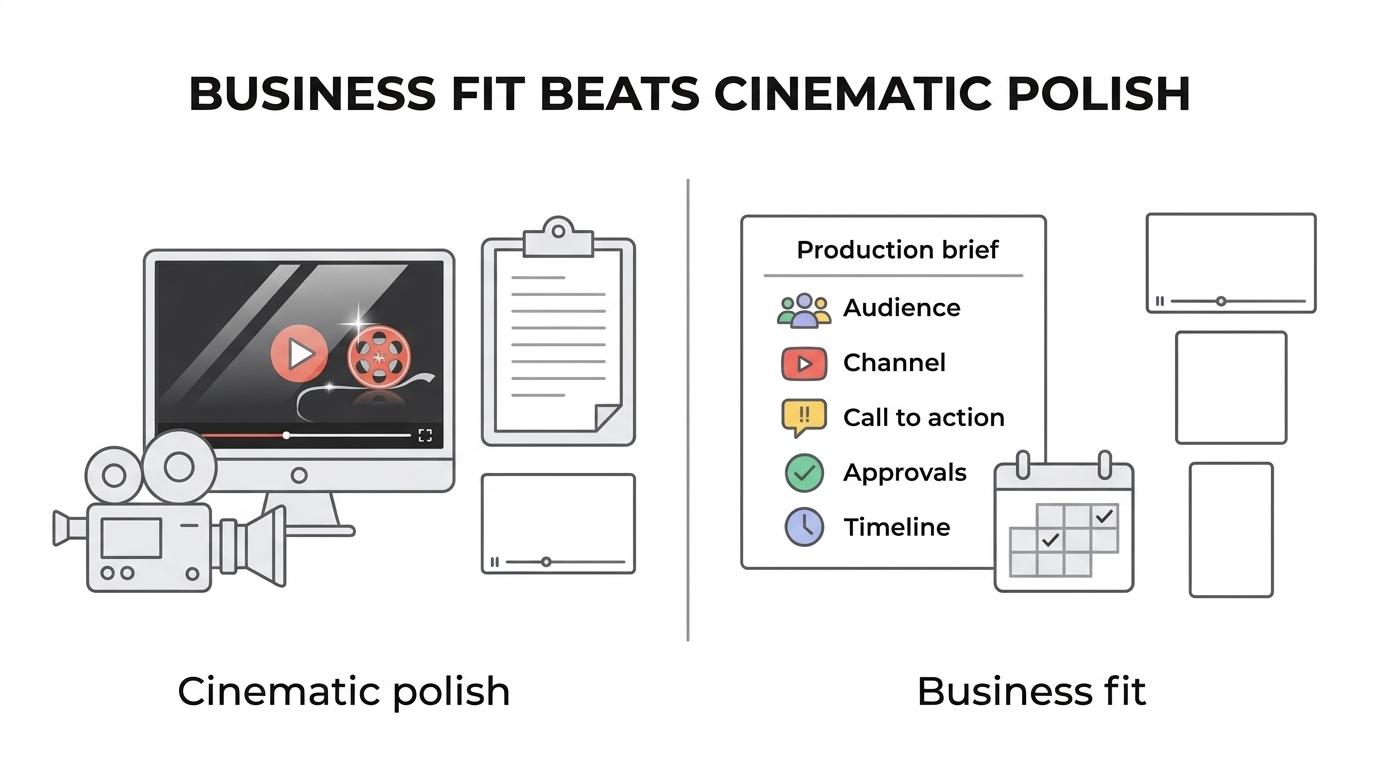
A common misconception is that a polished showreel proves strategic ability. It does not. A reel shows taste. A strong discovery process shows whether the team can build a video for a real objective, whether that is attracting talent in Edmonton’s tech sector, clarifying services for an oil and gas buyer, or increasing registration for a corporate event.
What should you ask about strategy before you ask about cameras?
Ask about audience, distribution, and the required action. Google’s video guidance and Wistia’s reporting both point to format choice and measurable outcomes as better buying criteria than gear lists alone.
Start with the viewer. Is the video meant for a homepage, LinkedIn, paid social, YouTube pre-roll, a conference screen, or an internal LMS? The right answer changes length, framing, pacing, captions, and even how interviews are structured.
Then ask what the viewer should do next. Google’s ABCDs framework includes Direction for a reason. If there is no clear call to action, the project may still look good, but it becomes hard to measure whether it moved anything forward.
Pro tip: ask how the company thinks about reach and frequency. One excellent 90-second film can underperform if the plan actually calls for short ad variants and repeated exposure. Strategy is not separate from production. Strategy shapes production.
What types of video production companies are Edmonton buyers shortlisting?
Edmonton buyers usually shortlist specialists by business use case, and Q Filmz Media fits the full-service corporate category with video, drone work, and post-production under one roof.
Most shortlists are not built around “best company” in the abstract. They are built around fit. Buyers typically compare options like these:
- Q Filmz Media: a full-service Edmonton provider suited to corporate video, event coverage, training content, brand storytelling, photography, and multi-format deliverables from one production plan.
- Boutique commercial studios: often a fit for ad-first creative with smaller deliverable counts and heavier concept development.
- Event-focused crews: useful when same-week highlight reels, speaker coverage, and event photography are the main priority.
- Freelance videographers: practical for simple single-camera updates, internal messages, or very narrow scopes.
- Animation specialists: better when the message depends on motion graphics, product visualization, or explainer-led storytelling.
In Edmonton, buyers often need cross-functional output. A municipal organization may want interviews, stills, b-roll, and vertical social clips from the same day. A University of Alberta department or a Telus World of Science partner campaign may need tighter brand controls and broader asset use. That is why category fit matters more than broad claims about creativity.
How should you compare project-based pricing, day rates, and monthly retainers?
The right model depends on volume and revision needs. A one-off project suits a launch, a day rate fits defined shooting, and a monthly retainer makes sense when your team needs repeat content across quarters.
Project-based pricing works best when scope is clear. You know the number of filming days, interview subjects, edit versions, and delivery formats. This is common for brand story videos, event recaps, or executive interview pieces.
Day rates can look simpler, but they shift more planning risk onto the buyer. If you choose a day rate, make sure pre-production, edit rounds, audio cleanup, graphics, and delivery formats are clearly itemized elsewhere. Cheap day rates can become expensive projects.
“Q Filmz Media offers half-day, full-day, project-based, and monthly retainer options because buyers do not all need the same cost structure.”
Monthly retainers make sense when video demand is continuous. If your marketing or HR team needs regular culture videos, recruitment clips, product updates, and event coverage, a retainer can reduce restart costs and improve consistency. The trade-off is commitment. If your internal priorities change every month, a retainer may create unused capacity.
What is a realistic corporate video budget in Edmonton?
A realistic budget starts with scope, not a flat market average. Interview videos, event recaps, training modules, and multi-location campaigns all price differently because prep, crew, shoot days, edits, and approvals change.
Wistia’s 2025 numbers are useful context here, but they describe video promotion and advertising budgets, not pure production cost. The point is still valuable: 41% of companies spent under $20,000 on promotion and advertising, while 28% spent over $20,000. Buyers are spending, but they are also scrutinizing where the money goes.
If you need a practical budgeting conversation, focus on the variables that actually move price:
- Pre-production: audience research, scripting, shot planning, location logistics, and approvals
- Production: crew size, cameras, lighting, audio, drone work, talent needs, and number of shoot days
- Post-production: editing, motion graphics, subtitles, music licensing, colour, revisions, and export versions
- Distribution needs: 16:9 master, 1:1 social cuts, 9:16 reels, paid ad variants, and thumbnail design
A common misconception is that a shorter runtime means a lower budget. A 30-second commercial can require more planning and more selective shooting than a three-minute internal training piece. If the concept needs high creative control, the cost driver is complexity, not duration.
How do you tell whether a production process will actually stay on schedule?
A reliable schedule is visible before cameras roll, and Q Filmz Media describes the same four-stage structure serious buyers expect: consultation, pre-production planning, production, and post-production.
When buyers ask us what predictability looks like, we look for milestones rather than promises. A provider should explain who signs off on the brief, when interview questions are approved, when the rough cut lands, and how revisions are handled. If those checkpoints are missing, “fast turnaround” is usually just a sales phrase.
One Edmonton-specific factor matters here too: logistics. Winter daylight, industrial site access, corporate calendar congestion, and executive availability can all change the schedule. A solid team plans around those realities instead of pretending every job follows the same template.
“Q Filmz Media says most projects take 2 to 8 weeks, depending on scope and complexity.”
A practical review process usually looks like this:
- Confirm business goal, audience, and approvals.
- Lock script, interview prompts, locations, and shoot date.
- Review the first edit against the brief, not against personal taste alone.
- Approve final exports based on channel requirements and deadlines.
Pro tip: ask what can delay delivery. The honest answers are often client-side approvals, location access, and extra format requests added after the shoot.
How should you scope formats and deliverables before filming?
You should scope formats before the shoot, not after it. One master edit rarely covers homepage, paid social, recruitment, internal comms, and event follow-up equally well.
This is where many buyers lose value. They commission a single flagship video, then later ask whether it can be cut into reels, ads, stills, or sales assets. Sometimes it can. Sometimes the footage was never captured for that purpose.
A smarter approach is to build a deliverables map in advance. Decide what must be captured for a 16:9 website film, a square LinkedIn cutdown, a 9:16 vertical clip, captioned social posts, and any photo needs tied to the same day. If the intended use is agreed before filming, one production can support awareness, consideration, recruitment, sales conversations, and internal updates.
That matters for teams managing lean budgets. Flat budgets do not always mean lower demand. They often mean each production has to do more work.
What should you look for in creative quality and ad effectiveness?
Look for work that earns attention and drives action. Google’s ABCDs framework makes this concrete: Attention, Branding, Connection, and Direction, with a clear call to action inside the edit.
Creative quality is not only sharp footage or cinematic lighting. Effective work introduces the brand clearly, builds a human or business connection, and tells the viewer what to do next. Google reports a 30% lift in short-term sales likelihood and a 17% lift in long-term brand contribution from the ABCDs approach.
That is a useful buying lens because it separates style from effectiveness. A dramatic opening shot is nice. It matters more whether the video earns attention early, makes the company memorable, and gives concise direction.
“Q Filmz Media plans company stories, product explanations, case studies, and short ads as separate viewer needs, not one generic video brief.”
Common misconception: cinematic equals commercial-ready. In paid media, a strong ad often needs faster pacing, earlier branding, and more explicit direction than a website brand film. If the company cannot explain that distinction, the creative may be attractive but inefficient.
How do you compare a strong portfolio with measurable business results?
The best choice balances both. A portfolio proves execution, while results conversations show whether the team knows how the video will be used and judged after launch.
Ask to see category-relevant work. If you are buying for corporate communications, training, recruitment, or event videography in Edmonton, ask for examples close to that use case. A beautiful music video or wedding film does not tell you much about executive interviews, stakeholder messaging, or internal rollout needs.
Then ask how performance is reviewed. The answer should mention more than views. Strong teams talk about completion rate, watch behaviour, landing page actions, click-throughs, conversion assists, sales enablement use, or recruitment response. If the brief was for an internal training program, they may talk about completion and clarity rather than public reach.
This is also where local knowledge helps. Edmonton buyers often need to speak to sector-specific audiences in energy, government, education, non-profit, or real estate. The sharper the audience fit, the easier it is to judge whether the work is actually doing its job.
How do you measure whether the video worked after launch?
Measure success against the job the video was hired to do. Wistia and Google both support looking beyond raw views to watch behaviour, conversion assists, click-throughs, branded search lift, and completed actions.
We suggest a simple if-then model. If the goal was awareness, track reach, frequency, view-through rate, and branded search trend. If the goal was lead generation, track click-throughs, assisted conversions, and sales team usage. If the goal was recruitment or onboarding, look at application quality, training completion, or time saved by internal teams.
A practical scorecard might include:
- Awareness: impressions, reach, frequency, and completion rate
- Engagement: average watch time, drop-off points, and clicks
- Business action: form fills, demo requests, conversion assists, or event registrations
- Internal use: onboarding completion, stakeholder adoption, or fewer repeat explanations from staff
If the production company never asks how success will be measured, that is a warning sign. Video is expensive enough that the reporting conversation should start before the shoot, not after publication.
If you are comparing providers for corporate video production in Edmonton, event videography in Edmonton, advertising video in Edmonton, or a broader Edmonton video production company, start with these nine questions and you will make a much cleaner buying decision. Ready to elevate your brand with professional video production in Edmonton? Contact Q Filmz Media today for a free project consultation.