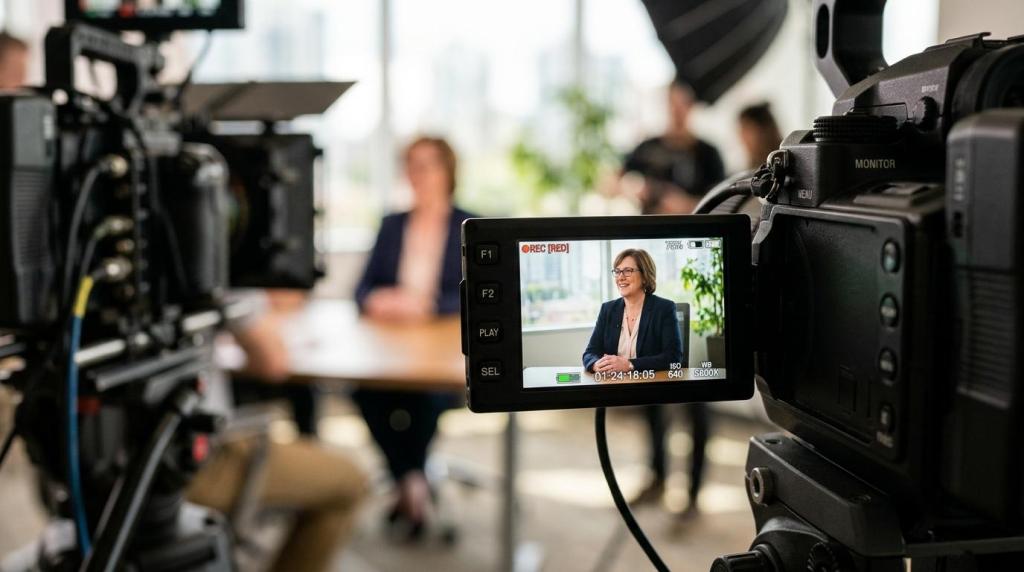
Promotional video helps B2B teams win trust when it gives buyers something concrete to believe, not just something polished to watch. At Q Filmz Media, an Edmonton video production company, we see the strongest results when a video explains a complex offer clearly, shows real people, and gives internal champions proof they can pass around the buying group.
TL;DR: Summary
- Promotional video builds B2B trust best when it shows proof, explains complexity, and matches the buyer stage; for Edmonton teams, Q Filmz Media often treats promotional, testimonial, and case-study video as different trust tools.
- LinkedIn B2B Institute reports nearly two-thirds of B2B buyers say social video helps shape buying decisions, and buyers known across the group from day one are 20x more likely to be bought.
- WARC’s review of 1,025 B2B effectiveness case studies says video helps reduce uncertainty and create shared understanding across stakeholders.
- Decision-stage trust usually comes from specifics: real customers, clear context, visual evidence, and a direct explanation of the problem, process, and outcome.
- If one shoot is planned around homepage use, service pages, proposals, sales follow-up, and social distribution before filming starts, the content usually works much harder.
That matters in Edmonton, where many purchases involve operations, finance, leadership, procurement, and end users, not just one buyer. A promotional video rarely closes a deal by itself, but it can make your company easier to understand, easier to remember, and easier to approve.
Why does promotional video build trust in B2B?
Promotional video builds B2B trust because it reduces uncertainty for real stakeholders. LinkedIn B2B Institute and WARC both describe video as a format that helps buying groups understand complex offers, compare options, and feel safer moving from interest to evaluation.
Trust in B2B is rarely emotional alone. It is also practical. Buyers want to know what your company does, whether your process is reliable, what risk looks like, and whether others like them have already chosen you. Video works well here because it can combine voice, visuals, context, and proof in a way that a short paragraph or static ad often cannot.
Think with Google reported that 70% of B2B buyers and researchers watched videos during their path to purchase. Nearly half watched 30 minutes or more, and almost one in five watched over an hour. That tells us something important: buyers do not avoid video when the topic is serious. They use it to make sense of serious decisions.
A common misconception is that trust starts only after awareness. In practice, being known early matters. LinkedIn B2B Institute says vendors known across the buying group from the start are 20x more likely to be bought than those known only through expert recommendation.
What makes buyers trust a promotional video instead of dismissing it?
Buyers trust promotional video when it shows proof, context, and human credibility. Q Filmz Media treats testimonial and case-study footage as trust assets because a real client story explains the problem, the decision, and the outcome more clearly than a polished slogan.
The first filter is relevance. Buyers trust what feels close to their situation. If the video shows a similar industry, a similar problem, or a similar team structure, viewers can picture themselves in the story. That is why a corporate video for an Edmonton engineering firm should not sound like a retail ad. The risk, stakes, and buying cycle are different.
The second filter is specificity. Broad claims like “we deliver results” are easy to ignore. A stronger approach is to show what changed, why the buyer chose that route, and what the process looked like. Even without revealing confidential numbers, you can still show operational detail, project constraints, or stakeholder concerns.
Q Filmz Media plans testimonial and case-study videos for service pages, sales follow-up, proposals, paid campaigns, and social channels, because trust content has to appear where buying decisions actually happen.
The third filter is pace and clarity. LinkedIn B2B Institute says buyers give an ad only 3.7 seconds of attention on average. If the opening feels generic, trust does not even get a chance to form. A person, a direct problem statement, or a sharp visual cue usually works better than a long animated logo.
What are the 9 trust-building jobs a promotional video can do for B2B teams?
The best promotional videos do more than create awareness. They help prospects recognize the problem, understand the offer, believe the proof, and share the case internally across finance, operations, procurement, and leadership.
A trust-building promotional video can:
- Simplify a complex offer so non-experts can follow it.
- Put real people on screen, which makes the company feel accountable.
- Show how the product, service, or process actually works.
- Give sales teams proof they can reuse in follow-up emails and proposals.
- Create shared understanding across the buying group.
- Reduce perceived risk by showing experience, process, and outcomes.
- Help internal champions explain the choice to senior leadership.
- Make the brand easier to remember before a formal RFP or shortlist.
- Support later-stage comparison when buyers are weighing similar vendors.
A common mistake is expecting one 60 to 90 second brand film to do all nine jobs equally well. In most B2B settings, one core promotional video works best when it is supported by shorter cutdowns, testimonial clips, or a more detailed case-study piece.
How should you match promotional video to the buying stage?
You should match the message to the decision stage. Awareness video earns attention, consideration video explains the offer, and decision-stage video proves outcomes through demos, case-study clips, or customer testimony.
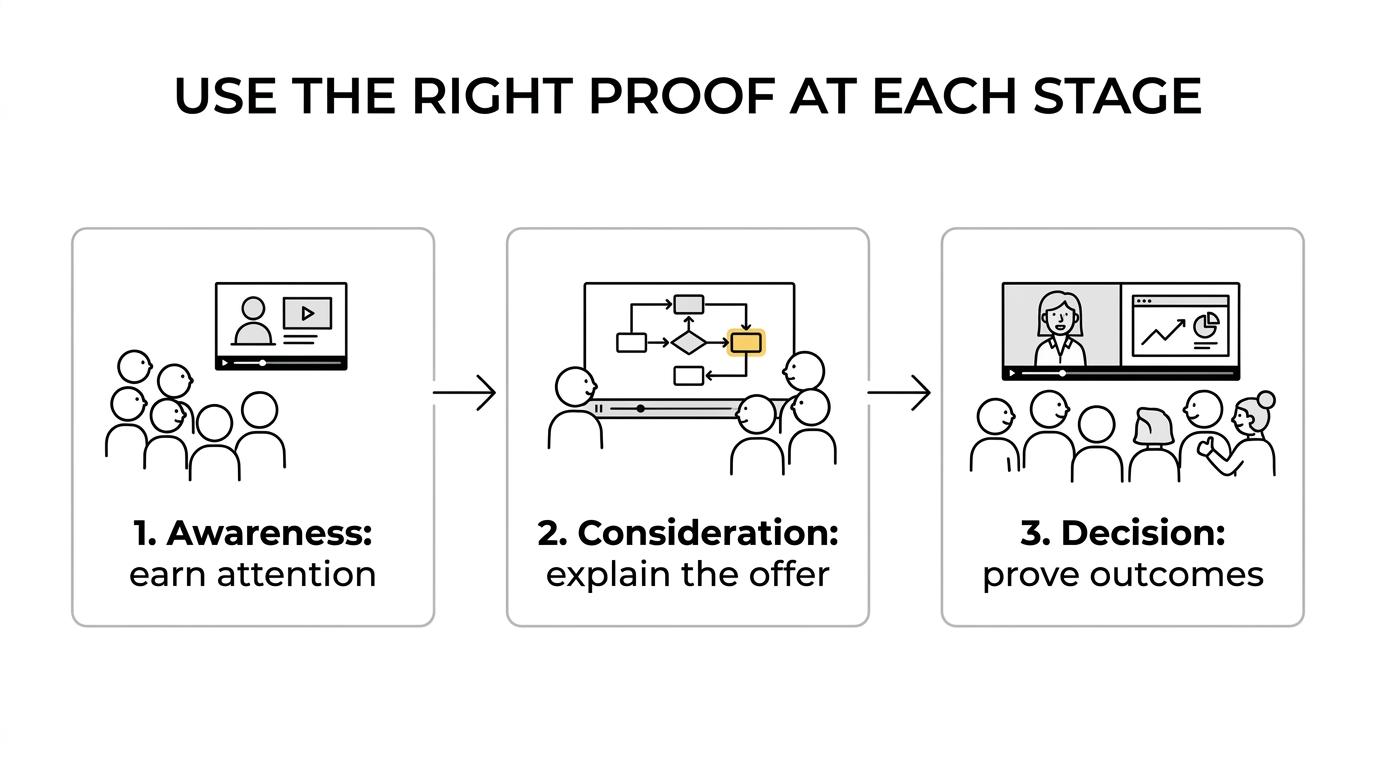
Step 1 is to map the questions buyers ask at each stage. Early on, they ask, “What is this?” and “Is this relevant to us?” Mid-funnel, they ask, “How does this work?” and “Why is this better than the alternatives?” Late in the process, they ask, “Can we trust this team?” and “What happens after we sign?”
Step 2 is to pick the right format for the question. A brand-led promotional video can open the door, but late-stage trust often needs more substance. If the viewer is already in a proposal review, then short clips answering implementation, support, or workflow questions can outperform a general brand piece.
Step 3 is to assign the destination before production starts. Homepage, service page, paid social, email follow-up, proposal deck, and recruiter outreach each need different framing. If you plan the usage first, one shoot can support far more than awareness.
Promotional video or testimonial video: which builds credibility faster?
Testimonial video usually builds credibility faster, while promotional video gives broader context. If your buyer already knows the category, a credible customer voice can outperform brand-led claims because it transfers trust from a peer to your offer.
Promotional video is useful when you need to introduce the company, frame the problem, or show the bigger story. Testimonial video is stronger when buyers need proof from someone who has already made the decision. In other words, promotional video often sets the stage; testimonial video often lowers the emotional and professional risk of saying yes.
This does not mean written testimonials are useless. It means video carries more context. Buyers can hear tone, see confidence, and judge whether the speaker sounds specific or scripted. That extra context matters in B2B, especially when the sale affects team workflows, budgets, or reputation.
Short social video or detailed case-study video: which helps a buying group decide?
Short social video creates reach; detailed case-study video supports decisions. LinkedIn data shows attention can be won or lost in 3.7 seconds, but buying groups still need longer proof when the offer affects budget, risk, or operations.
Short video is good at earning memory and early interest. It can put your company on the day one list, which matters because familiar vendors have a major advantage before formal evaluation begins. That is where short promotional cuts, executive clips, or brand story excerpts do their job.
Detailed case-study video does something different. It gives stakeholders shared language for the decision. WARC’s analysis points to this exact benefit: video helps teams align around what a solution is, how it works, and why it is credible.
A common misconception is that short-form content has replaced longer B2B video. It has not. Short clips create the opening. Longer proof creates the confidence to move.
How do you script a promotional video for complex offers without sounding generic?
A strong B2B script starts with the buyer’s problem, not your company history. The clearest scripts use plain language, one claim per beat, and proof from real people, processes, or results.
Step 1 is to define the audience as precisely as possible. A marketing manager, HR director, operations lead, and CFO will all listen for different signals. If the audience is mixed, write for the shared business concern first. That is usually risk, efficiency, growth, compliance, or credibility.
Step 2 is to build the script around tension and resolution. What problem is expensive, confusing, slow, or risky today? What changes after your service is in place? If the offer is technical, break it into visible outcomes rather than jargon. Buyers trust what they can repeat to someone else in one sentence.
Step 3 is to open with a human cue. LinkedIn B2B Institute says featuring a person or humour in the first seconds can keep viewers engaged longer. For most corporate teams, the safer play is not humour but immediate relevance: a direct line, a recognisable problem, or a face that signals authority.
How should Edmonton companies plan production so one shoot supports sales, recruitment, and marketing?
Edmonton companies should plan distribution before filming. Q Filmz Media builds corporate video production around the viewing context, because a service-page film, recruitment cut, event recap, and sales follow-up edit each need different footage, framing, and calls to action.
Step 1 is to create a usage map. We usually ask where the video will live first: homepage, LinkedIn, sales email, proposal, service page, paid campaign, or recruiting. That single decision changes interview questions, b-roll choices, orientation, runtime, and pacing.
Step 2 is to capture modular footage. Edmonton businesses often need the same shoot to serve more than one goal, especially in sectors like oil and gas, education, municipal services, tech, and non-profit. A day that includes executive interviews, process footage, employee interactions, and environment shots can support multiple edits without reshoots. That matters whether the location is a downtown office, an industrial site, the University of Alberta area, or an event venue like Telus World of Science.
With 100% in-house production and 500+ projects delivered, Q Filmz Media treats pre-production as the step that turns one Edmonton shoot into multiple usable assets.
Step 3 is to protect approval flow and deadlines. Promotional videos lose value when they stall in review. If legal, leadership, communications, and marketing need sign-off, build that sequence into the schedule early. Pro tip: one named decision-maker usually prevents most late-stage revision loops.
What metrics show whether a promotional video is actually earning trust?
Trust shows up in behaviour, not just views. Watch time, return visits, assisted conversions, proposal progression, sales-cycle movement, and multi-stakeholder sharing say more about credibility than raw impressions alone.
At the awareness stage, look at view-through rate, completion rate, and branded search lift. If people remember the brand and keep watching past the opening, the message is landing. LinkedIn B2B Institute also reports video-led campaigns are 3.2x more likely to report increased market share than non-video campaigns, which reinforces the value of staying visible early.
At consideration and decision stages, stronger trust signals include service-page engagement, click-through to contact pages, replay activity on testimonial segments, and whether sales teams keep reusing the video in follow-up. If a case-study video is regularly included in proposals and prospects mention it on calls, that is a trust indicator.
If a video gets views but does not help movement, ask a simple question: did it answer the right buying-stage question? Good production quality matters, but relevance to the decision matters more.
What mistakes make B2B promotional videos lose credibility?
The biggest credibility killers are vagueness, over-branding, and missing proof. Buyers stop trusting video when every claim sounds universal, nobody explains the context, and the footage looks disconnected from the actual product or team.
One common mistake is opening with too much self-congratulation. Buyers care less about your origin story than about their current problem. Another mistake is hiding complexity instead of clarifying it. In B2B, clarity beats cleverness. If the offer is complicated, say so, then make it easier to follow.
A third mistake is using one video as a substitute for the whole trust funnel. Buyers may need a short promotional video, a testimonial clip, a case-study story, and a sales follow-up asset at different moments. When those pieces work together, your company feels easier to evaluate and safer to choose.
If you are planning video for homepage trust, sales enablement, or buying-group education, you can also review our Corporate Video Production Edmonton and Edmonton Video Production pages for more planning detail. Ready to strengthen your brand with professional video production in Edmonton? Contact Q Filmz Media today for a free project consultation and quote.