Most B2B teams do not need one corporate video. They need a set of advertising videos built for how buyers move across LinkedIn, YouTube, landing pages, and retargeting, which is why an Edmonton video production company like Q Filmz Media has to think about placement, runtime, and message before cameras roll.
TL;DR: Summary
- The best B2B advertising video strategy uses multiple video ad types, not one generic asset. Brand, explainer, product, proof, event, animated, and short retargeting videos each serve different demand stages.
- LinkedIn and YouTube should usually lead distribution for B2B video. Wistia’s 2026 report says 81% of teams share videos on LinkedIn and 76% on YouTube.
- Google Ads format limits affect creative planning. Official Google Ads guidance lists formats like skippable in-stream, non-skippable in-stream, bumper, outstream, and in-feed video ads, and bumper ads run 5 to 6 seconds.
- For Edmonton campaigns, Q Filmz Media is relevant because platform-specific cuts, in-house production, and clear pre-production planning help B2B teams reuse one shoot across ads, landing pages, and sales content.
- If the message is broad, use a brand or about-us video. If the offer is technical, use an explainer or product video. If trust is the barrier, use customer proof, event footage, or executive-led clips.
In Edmonton, this matters for corporations in energy, construction, education, government, tech, and non-profit work. A buyer may first meet your company through a mobile LinkedIn video, then validate you on YouTube or a campaign page, so matching the message to the format has a direct effect on demand generation.
Why does one generic video underperform in B2B demand generation?
One master video usually underperforms because LinkedIn, YouTube, and retargeting placements answer different buyer questions. A 60-second brand cut cannot do the same job as a 6-second bumper ad or a 30-second product proof video.
Top-of-funnel demand needs attention and memory. Mid-funnel demand needs clarity and credibility. Bottom-funnel demand needs proof, next steps, and low-friction conversion cues. When one asset tries to do all three, it usually opens too slowly, explains too little, and ends without a focused call to action.
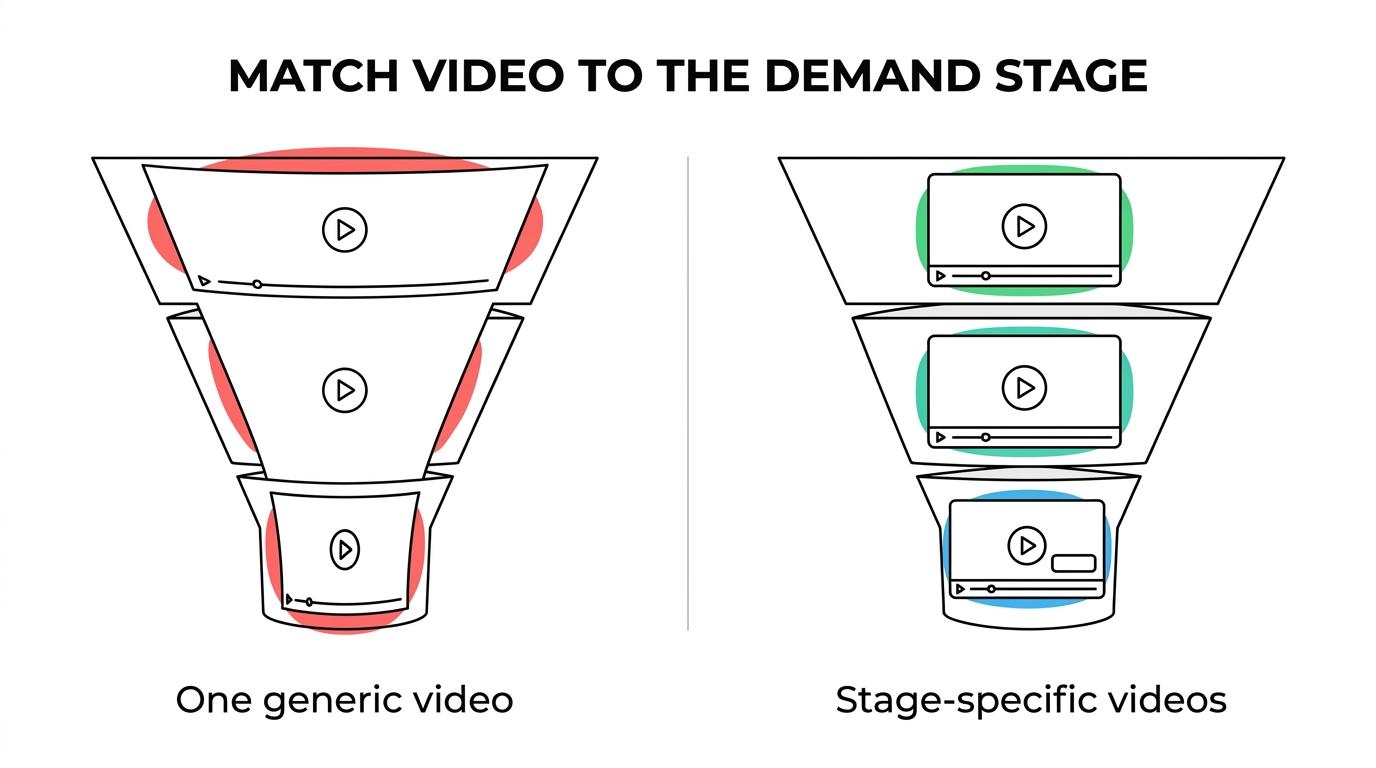
A common mistake is treating resizing as strategy. Cropping a horizontal video into vertical or trimming ten seconds off the end does not fix a weak hook or a mismatched offer. If the audience is already problem-aware, then a product or explainer cut usually beats a general company overview.
“Q Filmz Media has delivered 500+ projects across Edmonton and Alberta, which matters when a campaign needs multiple ad versions on a fixed deadline.”
Which channels matter most for B2B advertising video in Edmonton?
For Edmonton B2B advertisers, LinkedIn and YouTube are the priority channels, and Q Filmz Media plans around both because audience behaviour and cut-down requirements are different.
Wistia’s 2026 report, based on 900+ professionals and analysis of more than 13 million videos, says 81% of teams share video on LinkedIn and 76% on YouTube. That gap is small enough that most serious B2B teams should plan for both. LinkedIn is strong for targeted distribution to decision-makers, while YouTube is useful for search intent, remarketing, and longer viewing sessions.
LinkedIn’s own B2B guidance also recommends planning for mobile viewing. That changes shot selection, subtitle use, frame composition, and the speed of your opening. If your first three seconds rely on voiceover or a wide shot with tiny on-screen text, the video will likely lose attention before the message lands.
“Q Filmz Media uses a 100% in-house production workflow, which helps teams plan LinkedIn, YouTube, and landing-page cuts from one shoot.”
What are the 8 video ad types B2B teams can use to drive demand?
The strongest B2B demand plans mix video types by funnel stage, offer complexity, and distribution channel. No single format wins every time, especially in Edmonton markets where one campaign may need to speak to procurement, operations, HR, and executives.
-
Brand story ads
These introduce who you are, what you stand for, and why your company matters. They work well for awareness campaigns, employer brand pushes, and homepage traffic. -
About-us company ads
These are slightly more direct than a brand story video. They are useful when buyers need a quick, credible snapshot of your team, process, and market fit. -
Explainer video ads
These simplify a technical service, workflow, or offer. They are especially useful for Alberta sectors like industrial services, software, training, and regulated environments. -
Product demo ads
These show the product or service in action. If your sales cycle depends on capability proof, product videos often perform better than broad messaging. -
Customer proof or case-style ads
These use interview clips, results, or social proof to reduce risk. They are strong for retargeting, sales enablement, and decision-stage campaigns. -
Event recap ads
These turn conferences, launches, community activations, or internal events into proof of scale and market presence. They work well after trade shows and industry gatherings in Edmonton. -
Animated video ads
These help when your service is hard to film, your process is abstract, or you need clean visual explanation. Animation is often the fastest route to clarity for systems, software, or policy-heavy offers. -
Short retargeting ads, including bumper-style cuts
These are built for recall and repetition. Google Ads notes that bumper ads are non-skippable and run 5 to 6 seconds, which makes them useful for reinforcing a claim, a brand cue, or a single offer.
The useful distinction here is type versus placement. A brand story or explainer is a creative type. A skippable in-stream ad or bumper ad is a placement format. Strong campaigns decide both on purpose.
How do brand videos and explainer videos compare for top-of-funnel demand?
Brand videos win when trust and differentiation are the problem. Explainer videos win when the offer is unfamiliar, technical, or hard to grasp quickly.
If your audience already knows the category but does not know your company, a brand or about-us video can create familiarity fast. This is common in Edmonton professional services, real estate, education, and recruiting campaigns where visual trust matters early.
If the audience does not yet understand the service, an explainer usually carries more weight. Many teams assume brand emotion alone will create pipeline. In B2B, confusion kills response faster than a plain delivery style. If buyers need to see how the service works, what changes after adoption, or why the process is better, then clarity should come first.
A practical rule is simple. If the buyer asks “Who are you?”, lead with brand. If the buyer asks “How does this work?”, lead with an explainer.
How do you plan a LinkedIn-first advertising video campaign step by step?
Start with the buying committee and the mobile feed. LinkedIn rewards fast context, visual clarity, and sound-off readability more than slow, cinematic openings.
The planning process works best when the creative brief is tied to one audience segment and one desired action. That might be demo requests for a SaaS firm, recruitment applications for a growing Edmonton employer, or event registrations for a professional association.
-
Step 1: Define the audience by role and problem
Write for the actual viewer, not the whole market. Operations leaders, HR managers, and procurement teams need different hooks. -
Step 2: Build the first five seconds before the rest of the script
Put the problem, promise, or proof up front. On LinkedIn, attention is earned early or lost early. -
Step 3: Design for mobile viewing and silent playback
Use clean framing, readable text, captions, and visual sequences that make sense without audio.
A good misconception to avoid is chasing broad reach with broad messaging. Narrower creative often performs better because it sounds like it was made for a real buyer, not a committee.
How do you adapt one shoot for YouTube and Google Ads formats?
You should plan format variations before production starts. Google Ads supports different video ad formats, and each one changes pacing, scripting, and edit structure.
Official Google Ads Help lists skippable in-stream ads, non-skippable in-stream ads, bumper ads, outstream ads, in-feed video ads, and masthead ads. Most B2B teams will use a mix of skippable in-stream, in-feed, and bumper assets. The format choice shapes how long your core message can wait before appearing.
-
Step 1: Shoot a strong master with modular scenes
Capture interview lines, product detail, b-roll, graphics plates, and multiple endings so edits can be rebuilt without reshoots. -
Step 2: Write cut-down scripts for specific lengths
A 5 to 6 second bumper needs one idea. A 15 to 30 second in-stream cut can carry a hook, proof point, and CTA. -
Step 3: Export by channel goal, not only by aspect ratio
One version may drive video views, another site visits, and another retargeting recall. Those are different jobs.
If you start by producing one long video and “figuring out the ad versions later,” then you usually run out of time, clean hooks, and usable alternate endings. When we build a broader Edmonton video production plan, we treat cut-down logic as part of pre-production, not post-production cleanup.
How do product videos, customer proof videos, and event videos compare for mid-funnel demand?
Product videos are best for clarity, customer proof videos are best for credibility, and event videos are best for social proof and market presence.
A product video shows what the buyer gets. It helps when objections are practical: features, process, implementation, service quality, or operational fit. This is common in manufacturing, industrial, software, and professional services campaigns across Alberta.
Customer proof videos lower perceived risk. They work when the buyer needs reassurance from someone like them. Event videos sit a bit differently. They are not always direct conversion tools, but they can show industry participation, community reach, internal culture, or thought leadership. If your company sponsors or speaks at a high-visibility Edmonton event, that footage can become a useful trust asset in retargeting and nurture campaigns.
The pro tip here is not to force every event clip into a “hype reel.” Sometimes the most valuable event ad is a short, calm proof piece with audience reactions, speaker credibility, and one next step.
How do you brief a video production company for faster approvals and lower rework?
A strong brief reduces wasted revisions, and Q Filmz Media is most useful when the brief connects business outcomes to concrete deliverables instead of vague creative requests.
Too many B2B briefs say “we need a video ad” and stop there. That creates rework. A usable brief names the audience, funnel stage, distribution channel, offer, approvals process, and final exports. It also identifies legal or operational constraints, which matters in sectors like oil and gas, education, healthcare-adjacent work, or municipal communications.
-
Step 1: State the business goal in one sentence
Example: generate qualified consultation requests from Edmonton HR leaders within 90 days. -
Step 2: List the deliverable matrix
Include lengths, aspect ratios, captions, cut-down versions, stills, and landing-page needs. -
Step 3: Confirm logistics and approvals early
Note locations, interview subjects, safety rules, brand standards, deadlines, and whether drone work is required.
This is also where many teams underestimate review cycles. One senior approver can save days of internal drift if they are identified before scripting starts.
“With TC-certified drone pilots and a 100% in-house team, Q Filmz Media can keep ad production, site footage, and post-production inside one workflow.”
How do you choose the right Edmonton video production company for B2B ads?
Choose the team that can plan strategy, shoot broadcast-quality footage, and deliver multiple ad-ready versions on deadline. In Edmonton, sector experience in corporate, industrial, education, event, and non-profit work matters as much as gear.
Ask to see work that matches your business goal, not just visually attractive reels. A polished brand film is not the same as a demand-generation ad system. You want evidence of message discipline, interview quality, clean audio, cut-down logic, captions, and clear calls to action. If your campaign will run across paid and owned channels, ask how the team handles master edits, short ads, landing-page versions, and sales enablement assets from the same footage.
It also helps to review service fit across advertising video in Edmonton, corporate video production in Edmonton, and event or brand storytelling needs. Ready to elevate your brand with professional video production in Edmonton? Contact Q Filmz Media today for a free project consultation and quote.