
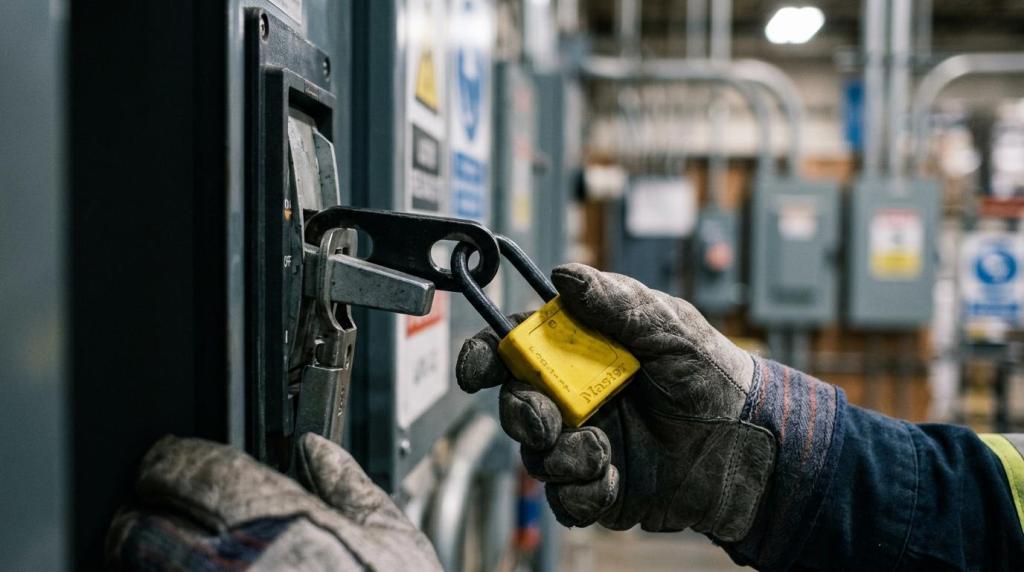
Training videos improve safety and compliance when they turn policies, procedures, and risk controls into actions people can actually repeat at work. For Edmonton organizations with multiple teams, rotating shifts, field crews, or regulated processes, that consistency matters as much as the message itself.
At Q Filmz Media, we see this first-hand in training and onboarding video production across Alberta. A well-produced training video does not just save classroom time. It helps standardize instruction, reduce avoidable variation, support documentation, and give staff a clearer picture of what “done correctly” looks like in the real environment.
Why training videos improve safety and compliance for Edmonton businesses
Safety and compliance training often breaks down when the same material is delivered differently across departments, sites, or supervisors. One team gets a thorough walkthrough. Another gets a rushed verbal summary. A third receives a dense PDF nobody remembers a week later. Video helps close that gap.
A strong training video gives every employee the same core instruction. That is especially useful for Edmonton employers in oil and gas, warehousing, construction, healthcare, education, municipal operations, and industrial settings where consistency is tied to risk reduction. If a lockout procedure, PPE sequence, incident reporting step, or equipment check must happen the same way every time, video is one of the best tools for showing it clearly.
There is also a practical business case. New hires can review training before their first shift, current staff can revisit modules before audits or recertification, and managers can use the same assets across locations. That helps with onboarding speed, recordkeeping, and quality control.
Just as important, video makes abstract rules easier to apply. Written policies explain what the rule is. Video shows what the rule looks like in context.
What official guidance and research say about safety training videos
The strongest case for training video is not that people “like video more.” It is that good video can support learning transfer. According to recent CDC guidance, effective training helps learners gain knowledge and skills they can apply in the workplace, and training effectiveness should be judged by learning and transfer, not learner satisfaction alone. You can review that guidance from the CDC here.
That point changes how companies should think about compliance content. If staff say a module was clear but still skip steps on the floor, the training is not doing its job. Safety training needs to affect behaviour, not just quiz scores or completion rates.
OSHA guidance has made a similar case for years. Realistic training can be very effective for teaching correct procedures and showing the consequences of not following them. OSHA also notes that videos can be effective for teaching job tasks and important information, especially when employees can participate fully and practise the skill or knowledge being taught.
The research is encouraging, with an important caveat. A 2026 meta-analysis covering 157 studies found safety training had a positive effect on trainee reactions, learning, and transfer, with smaller effects on broader safety indicators and health outcomes. In plain terms, training helps people learn and behave more safely, though injury reduction is influenced by many other factors as well, including supervision, equipment, workload, and culture.
Another useful study looked at compliance-oriented education for 363 healthcare professionals. The video group scored better on knowledge of standard precautions than the SOP-only and no-intervention groups at follow-up points. That supports what many teams already suspect: when procedures are shown well, people retain more than they do from text alone.
After looking at the evidence, a few points stand out:
- Learning transfer: training should help staff use the knowledge on the job, not just pass a module
- Behaviour change: safety training often shows stronger results in worker actions than in injury statistics
- Consistency: video reduces trainer-to-trainer variation across shifts, sites, and departments
- Engagement matters: passive viewing on its own is weaker than practice, dialogue, and realistic examples
What makes a training video effective for safety and compliance
Not every training video improves performance. Older research reviewing 95 quasi-experimental studies found that videos ranked among the least engaging safety training methods when used in a passive way. As training became more engaging, workers showed better knowledge acquisition and better safety outcomes. That means the question is not “Should we use video?” The better question is “How should we design the video and the rollout?”
The most effective training videos show real tasks, real environments, and real consequences. They model correct behaviour, use plain language, and focus on the decisions workers must make under normal job conditions. In Edmonton, that might mean filming inside an active facility, office, plant, clinic, warehouse, or job site instead of relying on generic stock footage that looks nothing like the workplace.
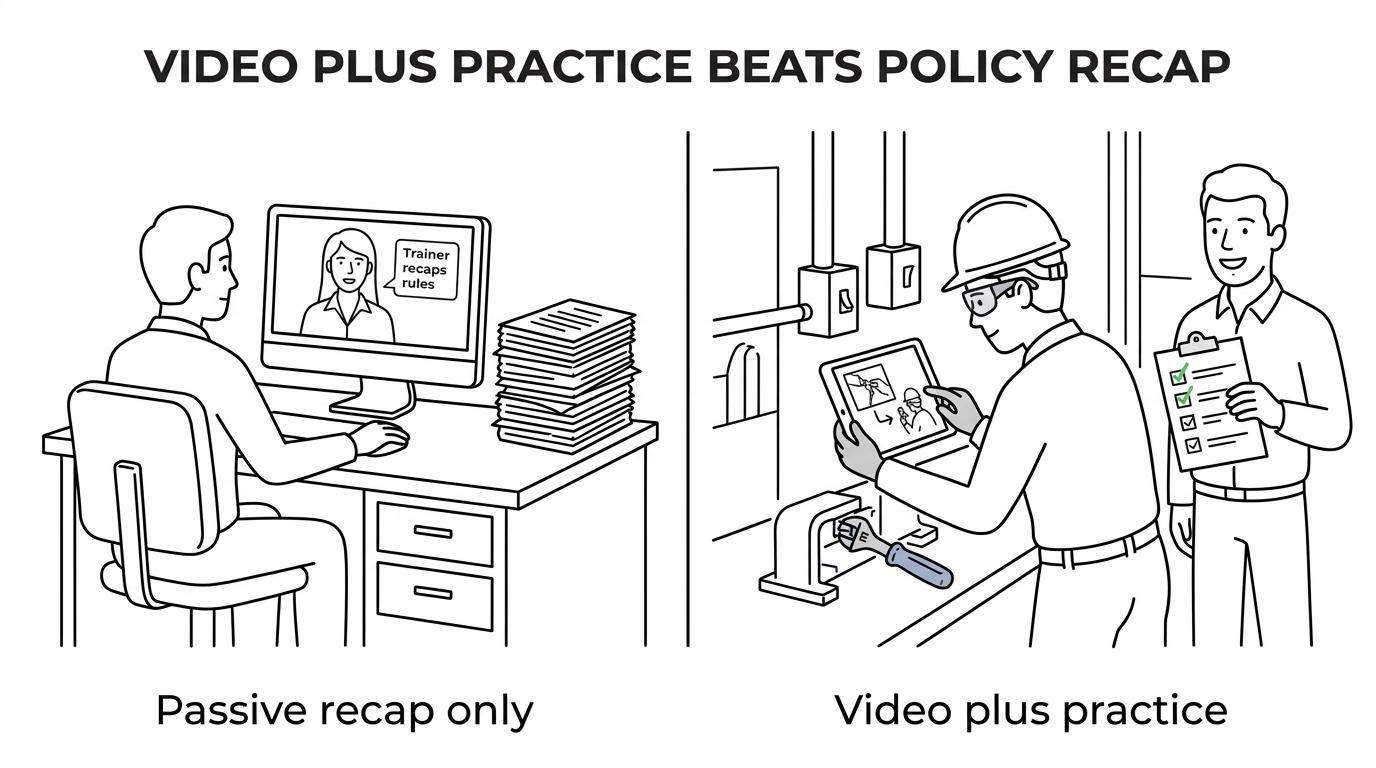
We also recommend treating training video as part of a system, not a stand-alone asset. A short filmed lesson paired with supervisor discussion, short quizzes, job aids, and practical demonstration usually performs better than a single long video no one revisits.
Good safety and compliance videos usually include these elements:
- Behavioural modeling: show the exact steps, pacing, and checks expected on the job
- Practice prompts: pause points, short assessments, or guided discussion after each module
- Realistic scenarios: common mistakes, near misses, and correct recovery actions
- short run times
- clear captions
- department-specific versions
- visible signage, tools, and PPE used at the actual site
A simple comparison makes the difference clearer.
| Training approach | What it looks like | Likely impact |
|---|---|---|
| Passive policy recap video | One person reads rules to camera | Better than no training, but weak retention |
| Filmed procedure demo | Step-by-step task shown in the real workspace | Stronger knowledge and consistency |
| Scenario-based safety video | Realistic mistake, consequence, and correction | Better decision-making and recall |
| Blended training video program | Video plus quiz, supervisor review, and practice | Best support for learning transfer |
How we produce training videos for Edmonton safety and compliance teams
At Q Filmz Media, we approach training video as a business tool, not just a filming day. As an Edmonton video production company with 100% in-house production, we plan each stage around the operational goal: safer behaviour, clearer compliance, faster onboarding, or more consistent instruction.
We often build these projects for HR leaders, operations managers, safety coordinators, and marketing teams who need broadcast-quality content that still works inside an LMS, internal portal, or onboarding workflow. That means scripting for clarity, filming for realism, and editing for retention.
If you are reviewing vendors for corporate video production in Edmonton or a larger Edmonton video production partner, the process matters just as much as the camera package.
Pre-production for training video production in Edmonton
This is where most training results are won or lost. We work with subject matter experts to identify the exact behaviours that matter, the risks involved, the audience’s baseline knowledge, and the situations where errors usually happen. Then we turn that into scripts, shot lists, visual references, and approval checkpoints.
For compliance content, we also recommend separating “must say” material from “must show” material. Policies often contain legal or technical wording that belongs on screen, while worker behaviour is better taught through filmed demonstration.
Production for corporate training videos in Alberta
On set, realism matters. We film in the actual environment whenever possible, using the right staff, supervisors, equipment, signage, and PPE. That makes the training more credible and easier for employees to map onto their daily work.
Our team handles production in-house, which helps keep quality and timelines under control. For industrial, campus, or large-facility training content, our TC-certified drone pilots can also capture safe, high-level context shots when they are useful for orientation, site access, or traffic flow instruction.
Post-production for safety and compliance video results
Editing is where clarity gets sharpened. We structure modules for attention span, add graphics for key steps, use captions for accessibility and noisy environments, and create cut-down versions for refresher training. We can also deliver courses in segments so teams can assign only the modules relevant to each role.
That streamlined workflow is one reason Edmonton organizations choose us for training and onboarding video production in Alberta. With more than 10 years in Edmonton and 500+ projects delivered, we know that deadlines are real and rollouts often connect to hiring cycles, audits, or policy changes.
Where training videos have the biggest impact in Edmonton industries
The value of training video changes by sector, but the pattern is consistent: when procedures need to be repeated accurately, video is a strong fit.
In Edmonton’s industrial and energy sectors, training videos are often used for field orientation, equipment handling, hazard communication, site access, and incident response steps. In healthcare and education, they can support standard precautions, student or patient privacy procedures, intake workflows, and emergency response. In municipal and non-profit settings, they are useful for volunteer orientation, public-facing service standards, and role-based onboarding.
Local organizations also deal with distributed teams. A campus department connected to the University of Alberta, a venue team near Telus World of Science, or a regional employer with city and field operations all face the same issue: not everyone learns in the same room at the same time. Video gives those teams a repeatable baseline.
Common use cases include:
- new-hire safety orientation
- compliance refreshers
- equipment operation walkthroughs
- incident reporting procedures
- supervisor communication training
- visitor and contractor site briefings
How to measure training video ROI for safety and compliance
The best way to measure impact is to look beyond completion rates. CDC guidance is clear on this point: learner satisfaction alone does not tell you whether training worked. A polished video with high view rates is still a miss if the right behaviour does not show up at work.
We advise Edmonton clients to track results at three levels. First, measure learning with short assessments. Second, measure transfer through observation, audits, and supervisor feedback. Third, measure operational outcomes over time, which may include fewer repeated errors, faster onboarding, better documentation consistency, or improved audit readiness.
Useful metrics often include the following:
- Learning: quiz scores, recall after 30 days, pass rates by department
- Transfer: observed procedure accuracy, PPE compliance, reporting consistency
- Operational impact: shorter onboarding time, fewer retraining sessions, cleaner audit trails
- Risk signals: near-miss trends, repeat violations, corrective action frequency
In many cases, the first measurable gain is consistency. Every employee sees the same instruction, every manager reinforces the same standard, and every refresher points back to the same source of truth. That does not replace leadership or supervision, but it gives both a stronger foundation.
If your organization needs training and onboarding video production that supports real safety and compliance outcomes, we can help. Ready to elevate your brand with professional video production in Edmonton? Contact Q Filmz Media today for a free project consultation and quote.