Buying a product video for B2B marketing is not just about getting a polished final edit. In Edmonton, where corporate buyers often need one asset to support sales, paid media, web pages, and internal approvals, the real value sits in the deliverables package around the video itself. At Q Filmz Media, we see product video requests succeed when buyers ask for assets that help prospects evaluate the product, not simply admire the brand.
TL;DR: Summary
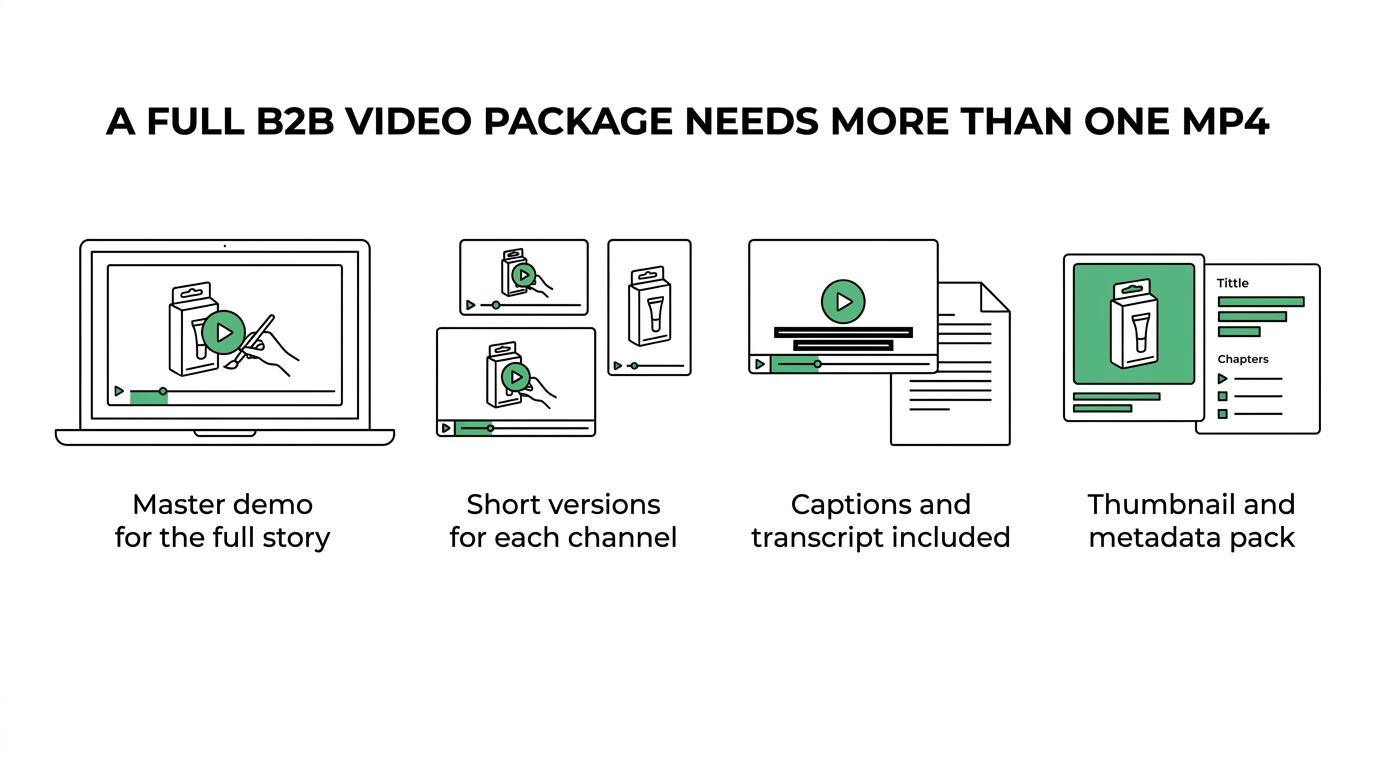
- The strongest product video deliverables for B2B buyers include a master demo, short cutdowns, captions, transcripts, thumbnails, and metadata with chapters or key moments.
- Google Merchant Center says product videos help customers evaluate fit, texture, scale, and real-world function, and those videos can appear in AI-driven placements, free Search listings, and Google Ads.
- LinkedIn B2B research says buyers may give a video only 3.7 seconds of attention, so the opening shot, message clarity, and sound-off readability matter.
- Q Filmz Media treats B2B product videos as multi-use assets for Edmonton companies, which means planning deliverables for search visibility, sales enablement, accessibility, and paid distribution from the start.
- Captions and transcripts are not the same deliverable: captions cover dialogue and meaningful audio cues, while transcripts support audio-only and video-only content and improve reuse across teams.
- If a vendor offers only one final MP4, you are probably missing assets that improve approval speed, ad performance, and long-term content value.
The good news is that most of these deliverables are easy to request before production starts. That matters because once the shoot is over, missing hooks, missing captions, or missing cutdowns usually cost more to fix than they would have cost to plan.
Why do product video deliverables matter so much in B2B buying?
They matter because B2B buyers judge both the product and the professionalism of the vendor from the asset package around the video. Google Merchant Center and Google Search can surface product videos with thumbnails, duration, and summary text, so the deliverables affect discoverability as much as presentation.
A B2B product video is rarely consumed in one place. It may live on a product page, travel into a sales deck, appear in LinkedIn paid media, and sit inside a procurement review. If your package only includes a hero edit, you are leaving value on the table.
Google’s own product-video guidance is useful here. Buyers want evidence of fit, texture, scale, and real-world function. That means the deliverables should support evaluation, not just awareness. A common mistake is assuming cinematic visuals alone will answer buyer objections.
“Q Filmz Media plans product video packages so Edmonton B2B teams can publish one shoot across search, sales, and paid distribution.”
How do you know a product video actually proves real-world function?
A product video proves real-world function when it shows the product being used in a believable operating context. Buyers need to see scale, handling, interface behaviour, setup steps, or output quality before they trust the claim.
For physical products, that might mean side-by-side scale shots, hands-on use, material close-ups, and a clear before-and-after result. For industrial equipment in Alberta, it often means showing workflow, safety context, operating environment, and the product’s role in a larger system.
For software or technical products, real-world function looks different. It may be screen capture, interface navigation, user roles, or integrations. If the product solves a specific business problem, the video should make that problem visible fast.
Many buyers still approve videos that open with abstract branding or drone footage and only reach the product after 20 seconds. That works poorly when the viewer is part of a buying group with limited time. Google’s B2B research has also said 92% of buyers already have a shortlist before they begin the process, so your video needs to reinforce credibility early, not warm up slowly.
What are the 9 product video deliverables B2B buyers should request?
The best package includes both creative files and utility assets. If you request these nine deliverables up front, your product video will be easier to use across search, paid campaigns, web pages, and sales follow-up.
Here are the nine deliverables we recommend:
- Master product demo: The full core video that explains the product, use case, and proof points.
- Short hook cut: A 6 to 15 second version designed to win attention in the first scroll or ad view.
- Mid-length promotional cut: A 30 to 60 second version for LinkedIn, landing pages, and retargeting.
- Feature-specific clips: Modular edits focused on one feature, workflow, or buyer objection each.
- Use-case or industry versions: Variants tailored to sectors like oil and gas, education, tech, or public sector procurement.
- Caption files: Usually SRT or VTT files, plus an open-caption export if needed.
- Full transcript: A clean text version for accessibility, SEO support, repurposing, and approvals.
- Thumbnail or poster frame options: Still images that improve click-through and presentation quality.
- Metadata pack with chapters: Video title, summary, duration, and key moments that support search visibility and better navigation.
If your vendor only lists “final video delivery” in the proposal, ask what that really includes. One MP4 is not a complete B2B deliverables package.
How should you review the first 3.7 seconds before approving a video?
The first seconds need to show the product, the problem, or the outcome immediately. LinkedIn B2B Institute research puts buyer attention at just 3.7 seconds, so the opening is not a stylistic detail. It is a conversion filter.
We suggest a simple approval test before final sign-off:
- Open on proof: Show the product in use, a strong result, or a recognisable operating context.
- State the value fast: Put the key claim or use case on screen within the first beat.
- Design for sound-off: Assume the viewer is muted and make the message readable with captions and clear supers.
If the opening shot could belong to almost any company, it is too generic. If the first line only makes sense with audio on, it is too fragile for paid distribution. Many Edmonton corporate teams get better performance by treating the first few seconds as a separate deliverable decision, not just part of the edit.
What is the difference between captions and transcripts?
Captions and transcripts are different deliverables, and you should ask for both. Section 508 guidance and HHS accessibility guidance make that distinction clear.
Captions are timed to the video. They include dialogue and meaningful audio cues, which can include music changes or sound effects when those sounds affect meaning. Closed captions can often be turned on or off by the viewer, while open captions are burned into the video and remain visible throughout.
Transcripts are text documents that describe the content in a readable format. They are especially useful for audio-only and video-only media, animations, internal reviews, content repurposing, blog support, and search summaries.
A common misconception is that a transcript file can replace captions. It cannot. If your team plans to publish on landing pages, LinkedIn, product pages, or training portals, captions improve accessibility and message retention in sound-off viewing. The transcript supports reuse, indexing, and documentation.
Should you ask for one master video or multiple cutdowns?
Multiple cutdowns are usually better than a single master file. Q Filmz Media treats the hero edit as the centrepiece, then builds shorter versions for product pages, LinkedIn, retargeting, and sales outreach so the same footage works harder.
The trade-off is simple. A one-file delivery is cheaper at the start, but it often creates weak ad performance and extra revision costs later. Multiple cutdowns take more editing time, yet they reduce the need for reshoots and let each team use the right length for the right channel.
This matters in B2B because different stakeholders want different depths of information. Procurement may want proof and detail. Marketing may want a short attention-grabber. Sales may want a version that tees up a live demo. If one video tries to do everything at once, it usually underperforms everywhere.
“With over 20 years in corporate video production, Q Filmz Media builds product video deliverables around buyer proof, fast approvals, and deadline-driven rollout.”
How do you check whether metadata and chapters support search visibility?
Search visibility improves when the video package includes metadata, a strong thumbnail, and meaningful video sections. Google Search Central has noted that ecommerce videos can appear in Search with thumbnail images, playback duration, and summary text, and key moments can help users jump to specific sections.
Step one is to ask for a title and summary that match buyer language, not only internal product terminology. If buyers search for “industrial valve monitoring system” and your video is labelled with a vague campaign name, you are harder to find.
Step two is to structure the edit so chapters make sense. A product video often breaks naturally into problem, overview, feature one, feature two, proof, and call to action. If those moments are clean, your team can use them on the page, in sales follow-up, or in search-oriented implementations.
Step three is to request thumbnail options that clearly show the product. If the thumbnail does not reveal the object, interface, or use case, you lose context before playback starts.
Google Merchant Center has also said product videos can appear across AI Mode, free Search listings, and Google Ads campaigns. That makes metadata a practical deliverable, not a technical afterthought.
How can you confirm the package is accessible and reusable across teams?
You confirm it by checking file types, usage scenarios, and ownership before production begins. Accessibility and reuse should be part of scoping, not last-minute extras.
Start with formats. Ask for delivery specs for web, social, presentation, and archive use. If your sales team embeds clips in email follow-up or decks, then lightweight exports and thumbnails matter. If HR or customer success will reuse the footage for onboarding, then feature modules and transcript cleanliness matter.
Next, check accessibility assets. If the product video will live on public pages, ask for captions, transcript text, and readable on-screen graphics. If the asset includes only stylised motion text without a transcript or captions, some teams will not be able to repurpose it efficiently.
Then review modularity. If one product launch needs a long demo, a short ad cut, and a booth loop for an Edmonton trade show, the footage should be planned for all three uses. Pro tip: request B-roll selects and clean graphics exports if your internal team may need future updates.
What should Edmonton buyers ask before hiring a product video production company?
Edmonton buyers should ask how the company handles strategy, proof of product use, accessibility assets, and channel-specific delivery. A product video provider should be able to explain pre-production, production, post-production, and how the final package supports search, sales, and paid distribution.
Ask how they will show fit, scale, texture, or real-world function for your product category. Ask whether captions and transcripts are separate line items or standard deliverables. Ask what cutdowns are included and whether thumbnails, metadata, and chapters are part of handoff.
Also ask operational questions. Is production in-house? Who manages revisions? How fast is turnaround when a launch date cannot move? Those details matter for Edmonton companies working across manufacturing, tech, energy, education, and public sector schedules.
When should Edmonton B2B teams use a specialist production partner instead of a generic videographer?
Use a specialist when the asset must satisfy multiple business functions at once. Q Filmz Media handles Edmonton video production for corporate teams that need broadcast-quality visuals, structured deliverables, and a streamlined process that fits real business timelines.
A generic videographer may capture attractive footage, but B2B product marketing usually needs more than attractive footage. It needs pre-production that maps buyer questions, shooting that proves function, and post-production that creates reusable versions for web, sales, ads, and accessibility.
That is especially true in Edmonton, where product marketing often crosses sectors and audiences. A single campaign may need to speak to operators, procurement teams, executive buyers, and technical evaluators. We see stronger outcomes when the production scope includes the full deliverables stack, not just filming day coverage.
If you are comparing options, review the related service pages for Edmonton video production, corporate video production in Edmonton, and advertising video production in Edmonton. That will help you compare whether a team is built for commercial product storytelling or only for simple video capture.
Ready to strengthen your launch, sales enablement, or product marketing with professional video production in Edmonton? Contact Q Filmz Media today for a free project consultation.