
Corporate video procurement often goes wrong before the camera rolls. When Edmonton buyers treat deliverables as a post-production detail, they end up paying for change orders, missing platform specs, or publishing videos without the accessibility assets their organization actually needs. At Q Filmz Media, we see the strongest projects start with a locked deliverables plan, not just a creative brief.
TL;DR: Summary
- Procurement teams should lock corporate video production deliverables before filming starts because platform rules, accessibility requirements, approval workflows, and runtime choices all change what must be captured and edited.
- For Edmonton video production projects, Q Filmz Media plans audience, timeline, approval owner, and distribution platforms early because those decisions affect interview questions, framing, b-roll, graphics, and final versions.
- The core deliverables usually include a master video, short cutdowns, vertical versions, caption files, transcripts, accessibility support, internal or stakeholder edits, and channel-specific exports.
- Google Ads format rules matter: bumper ads are 6 seconds, non-skippable in-stream ads run 15 to 60 seconds depending on subtype, and skippable in-stream ads have no maximum length, though videos under 3 minutes are recommended.
- Accessibility is part of scope, not an add-on: W3C WCAG requires captions for prerecorded audio in synchronized media, and may require audio description or a media alternative for prerecorded video.
- Shorter videos often win on engagement, but longer replays, training content, and executive interviews still have value when the use case justifies them.
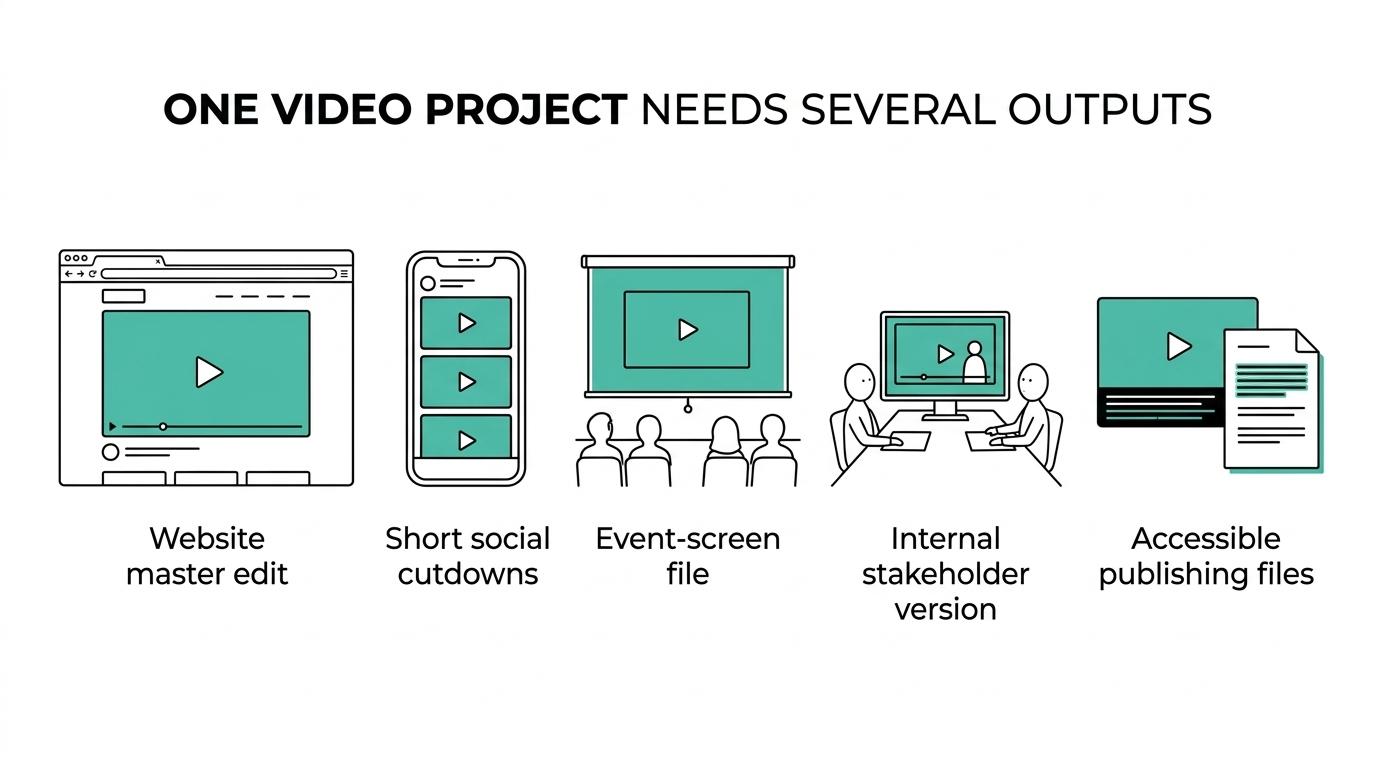
That matters for corporate video production in Edmonton because one project often needs several outputs at once: a website edit, LinkedIn cutdowns, an event-screen file, an internal version, and accessible publishing files. If procurement defines those versions early, the production team can shoot for the real distribution plan instead of trying to rescue missing assets later.
Why should procurement lock corporate video deliverables before production?
Yes, procurement should lock deliverables before production because Google Ads, W3C accessibility rules, and approval timelines all affect what footage gets captured. Q Filmz Media builds this into early planning so the creative goal, people involved, schedule, approvals, and final outputs stay visible from the start.
A common misconception is that deliverables are just export settings chosen at the end. They are not. If you need a 16:9 website master, a 9:16 vertical cut, open captions, leadership snippets, and an internal edit, those needs influence script length, shot composition, interview pacing, on-screen graphics, and how much b-roll the crew captures on location in Edmonton.
“Q Filmz Media plans audience, timeline, approval owner, filming locations, and publishing platforms before production starts, because each one changes the final deliverables.”
If your legal team needs a compliance review, then versioning has to be built into the schedule. If HR needs a recruitment cut while marketing needs a brand story, then the interview questions must serve both objectives. That is why procurement should treat deliverables as scope, not as an afterthought.
How do platform rules change what must be delivered?
Platform rules directly change the deliverables list because YouTube, LinkedIn, internal LMS platforms, and event screens do not use the same runtimes, aspect ratios, or caption behaviours. If distribution is mixed, your video package must be mixed too.
Start with the channel list. If the video will run as paid media, check the ad format first, not last. Google Ads states that bumper ads are 6 seconds long, with a minimum of 5 seconds. It also lists non-skippable in-stream ads at 15 to 60 seconds depending on campaign subtype, while skippable in-stream ads have no maximum length, though videos under 3 minutes are recommended.
Then translate those rules into production needs. A 6-second bumper ad requires a single clear message and bold visuals. A 60-second recruitment cut needs a stronger narrative arc. A full-length leadership video may need calmer pacing, longer answers, and fewer aggressive transitions.
Pro tip: ask the production partner to define aspect ratios at the same time as runtimes. If you wait until post-production to request vertical and square crops, you may learn too late that lower-third graphics, group shots, or product framing do not translate cleanly to 9:16.
What are the 8 corporate video deliverables procurement teams need?
Most corporate video projects need more than one final file. The safest procurement approach is to scope a small family of assets that matches where the content will actually be used.
After the master objective is defined, we recommend confirming these eight deliverables before approvals and purchase orders are finalized:
- Master brand or corporate edit: The main 16:9 version for the website, sales use, or campaign landing page.
- Short paid-media cutdowns: Commonly 6, 15, and 30-second versions for YouTube, LinkedIn, or display placements.
- Vertical or social-first exports: 9:16 and sometimes 1:1 crops for mobile viewing and silent autoplay environments.
- Open captions and sidecar caption files: Burned-in captions for social plus SRT or VTT files for accessible publishing.
- Transcript and text-based media support: Useful for compliance, repurposing, search visibility, and internal review.
- Internal or stakeholder version: A tailored edit for employees, board members, partners, or training audiences.
- Event or replay file: A longer export for conference screens, town halls, webinars, or post-event hosting.
- Thumbnail, stills, or cover assets: The visual package that helps distribution teams publish quickly across channels.
Not every Edmonton corporate video needs all eight. A training video may need fewer ad cutdowns but more transcript support. A corporate event recap may need a fast turnaround social package plus a replay file. The point is not to order everything. The point is to order the right set on purpose.
How do captions, transcripts, and audio description compare in scope?
Captions, transcripts, and audio description are different deliverables, not interchangeable ones. W3C WCAG 2.0 treats captions for prerecorded audio content in synchronized media as a requirement, and it also requires audio description or a media alternative for prerecorded video content in synchronized media in many cases.
A transcript is the text of the spoken content. Captions are timed to the video, which makes them usable during playback. Audio description explains visual information that a blind or low-vision viewer may not otherwise catch. If procurement only asks for a transcript, the organization may still be missing what is needed for accessible publishing.
“Q Filmz Media typically delivers most video projects in 2 to 8 weeks, so approval timing should be scoped with captions, alternate versions, and final publishing files.”
This is where many budgets go sideways. Teams assume captions can be added instantly, but accurate captioning still needs review for spelling, timing, speaker names, acronyms, and branded terminology. If your organization serves public audiences, education, healthcare, or government-adjacent stakeholders in Alberta, accessibility should be treated as a core scope line.
How do short cutdowns compare with full-length corporate videos?
Short cutdowns usually drive stronger engagement, while full-length versions still matter for training, investor context, event replay, and executive communication. The right answer depends on distribution intent, not on a fixed “best” runtime.
Wistia’s 2026 State of Video report surveyed more than 900 professionals and analyzed over 13 million videos and 79 million hours of viewing data. One of the clearest takeaways is that shorter videos tend to have higher engagement rates. That supports the case for cutdowns in paid and social campaigns.
That does not make longer videos obsolete. If the goal is onboarding, a detailed product walkthrough, or a recorded keynote from an Edmonton industry event, longer form content can still be the right asset. The mistake is assuming the master edit can serve both jobs equally well.
If attention is scarce, then a shorter front-end asset should carry the campaign. If detail and trust are the priority, then a longer companion piece may deserve a place in the deliverables list. We often advise buyers to scope both rather than force one edit to do everything.
How can procurement turn distribution channels into a deliverables matrix?
A deliverables matrix is the fastest way to convert strategy into scope. It links each channel to its audience, runtime, format, accessibility need, and approval owner.
Start by mapping the distribution plan in one simple framework. This is often more useful than a long creative memo because it shows where each asset will live and who must approve it.
- Channel: Website, YouTube, LinkedIn, event screen, LMS, internal intranet
- Audience: Buyers, recruits, employees, partners, investors, event attendees
- Runtime: 6 seconds, 15 seconds, 30 seconds, 90 seconds, 3 minutes, full replay
- Format: 16:9, 1:1, 9:16, muted autoplay, presentation playback
- Accessibility: Open captions, SRT/VTT, transcript, audio description, media alternative
- Approval owner: Marketing, HR, legal, procurement, executive sponsor
Pro tip: give every deliverable a business purpose. If a version has no clear channel or owner, cut it before production. Edmonton organizations often save budget this way, especially when multiple departments want “just one more version” that never gets published.
How should approval workflows shape file versions and edit rounds?
Approval workflows should define file versions because each approver adds time, and time changes both delivery dates and editing scope. If you need legal, HR, and executive sign-off, that process must be priced and scheduled upfront.
Step one is to name the approval owner. One person should consolidate notes. When five stakeholders comment separately, editors spend time reconciling contradictions instead of improving the cut.
Step two is to define the review rounds. Two structured rounds are very different from open-ended revision cycles. Procurement should ask what counts as a revision, what triggers a change order, and whether versioning includes caption updates, graphic changes, or alternate exports.
Step three is to define final handoff. Ask for file naming standards, export specs, and whether the package includes both web-ready and archive-ready files. A common misconception is that “final delivery” means one MP4. In practice, the marketing team may need several finals for different publishing environments.
What should Edmonton procurement teams ask before signing a video production scope?
Edmonton procurement teams should ask channel, accessibility, turnaround, approval, and usage questions before signing scope. In Alberta sectors like energy, education, public service, and technology, those answers often matter more than the creative treatment alone.
Ask where the video will live first. A recruitment campaign, corporate event recap, training module, and homepage brand film each create different deliverables. Then ask how silent autoplay, bilingual needs, or accessibility obligations affect the package.
Ask about location realities too. Filming in offices, industrial settings, or public venues around Edmonton changes logistics, sound control, drone planning, and scheduling. If the project involves campus, museum, or event environments, then permits, access windows, and stakeholder approvals should be reflected in the deliverables timeline.
For buyers comparing scope options, our corporate video production in Edmonton page and our Edmonton video production overview can help frame the right questions before vendor selection.
How do you compare Edmonton video production vendors on deliverables, not just price?
The strongest vendor comparison looks at deliverable planning, accessibility readiness, turnaround discipline, and channel fit, not only at the day rate. That broader view mirrors Gyroid Technologies’ criteria for choosing an industrial video production partner, where planning discipline and fit for the intended use case matter more than a headline quote alone. A lower quote can become the expensive option when key versions are missing.
Start with what is included. Some proposals cover one master edit and leave captions, cutdowns, stills, and alternate aspect ratios outside the base scope. Others build those assets into the original plan. Price only makes sense when the deliverables set is truly comparable.
Then check production structure. An in-house team can reduce handoff friction, which matters when procurement needs consistent communication and tight deadlines. This is especially relevant for Edmonton corporate teams balancing brand, HR, operations, and executive stakeholders on the same project.
Look closely at timeline language as well. Fast turnaround only helps if the quote also explains approvals, revision limits, and final handoff formats. If the vendor cannot state what files you will receive, in what ratios, with what accessibility support, and on what timeline, the scope is still incomplete.
Ready to get the deliverables right before production starts? Contact Q Filmz Media today for a free project consultation and quote for corporate video production in Edmonton, Alberta.