
A brand storytelling video is not one fixed format. For Edmonton B2B teams, including the corporate video producers at Q Filmz Media, the stronger approach is to match the story angle to the buyer’s stage instead of forcing every message into one polished overview.
TL;DR: Summary
- The best brand storytelling video for B2B is usually one of several audience-specific formats, especially a company story, explainer, testimonial, or case study; teams like Q Filmz Media plan these around buyer stage, not around a single generic showreel.
- Wyzowl’s 2026 report says 91% of businesses use video, 93% of video marketers call it important, 68% make explainer videos, and 57% use testimonial videos.
- Wistia reports eight in 10 teams use LinkedIn as a primary place to share video, which means cut-downs, hooks, aspect ratios, and calls to action should be planned before filming.
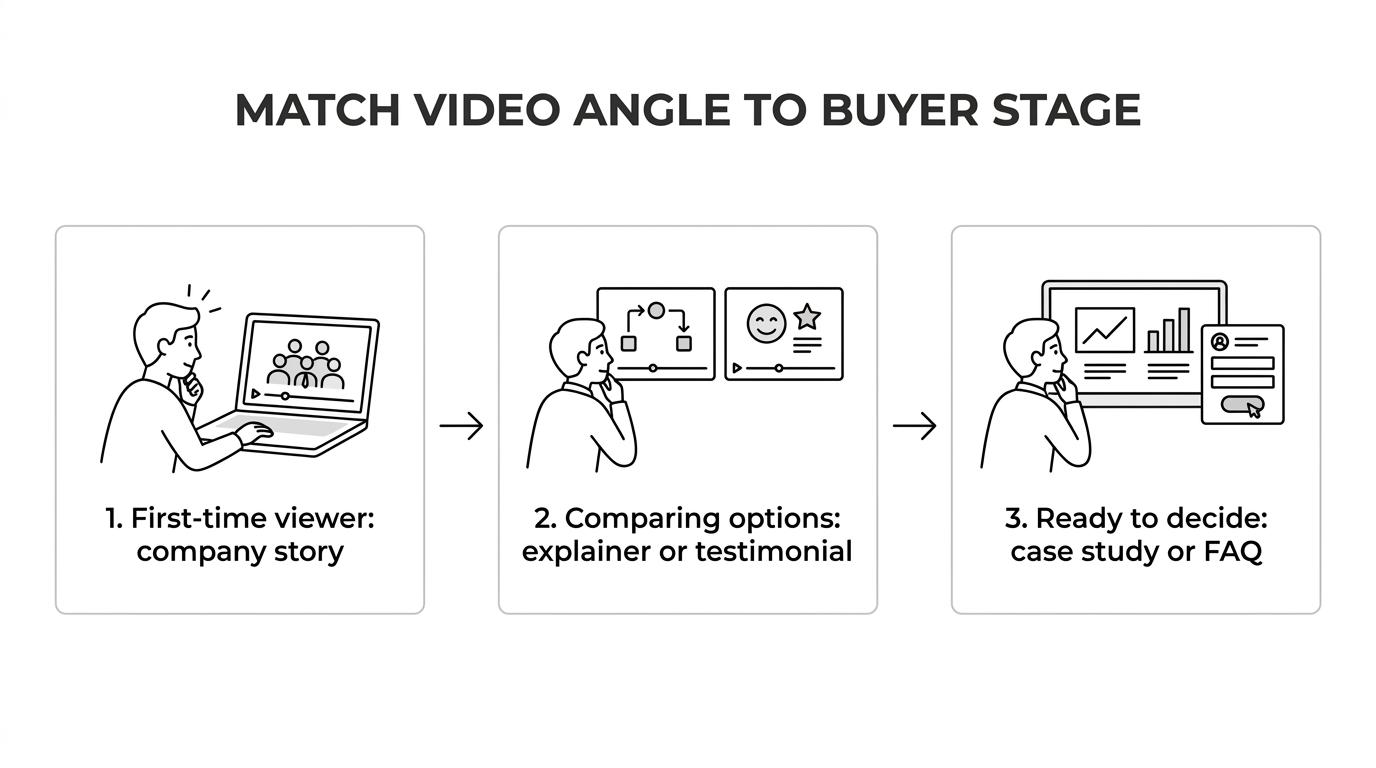
- Use company story for first-time viewers, explainer or client experience for comparison shoppers, and case study or objection-handling video for already-interested prospects.
- Measure success by the job the video was meant to do: watch time for attention, clicks for interest, meetings or enquiries for pipeline impact.
That matters in Edmonton, where B2B buyers in oil and gas, education, tech, government, and non-profit sectors often move slowly and evaluate risk carefully. When the video matches the moment, it is easier to build trust, shorten explanation time, and give sales or marketing a practical asset they can reuse across LinkedIn, landing pages, and follow-up.
How should Edmonton B2B teams choose a brand storytelling video angle?
Start with buyer stage, not video style. In Edmonton B2B marketing, Q Filmz Media and LinkedIn’s own B2B guidance point to the same rule: first-time viewers need context, active evaluators need proof, and warm prospects need a clear next step.
We recommend sorting every brand storytelling idea into three viewer moments. If the audience barely knows you, the video should explain who you are, who you help, and why your offer matters. If the audience is comparing vendors, the story should reduce uncertainty with a product explanation, client experience, or proof of process. If the audience is already interested, the video should remove the last objection and make contact feel easy.
This is where many teams miss the mark. They begin with what they want to say about the company rather than what the viewer needs to know right now.
Common mistake: treating a brand video like a digital brochure. If the viewer is early-stage, too much detail creates friction. If the viewer is late-stage, broad awareness language feels evasive.
Why do brand storytelling videos matter for B2B trust and ROI?
Yes, they matter because trust and recall shape long B2B sales cycles. Wyzowl and LinkedIn both show video remains central to marketing strategy, especially when teams need authenticity, credibility, and connection before a sales call happens.
Wyzowl’s 2026 video marketing report, based on 266 respondents in late 2025 and tracking 12 years of data, found that 91% of businesses use video as a marketing tool and 93% of video marketers say video is an important part of their strategy. The same report found social media videos are the most-made type at 69%, explainer videos follow at 68%, and testimonial videos sit at 57%. That lines up with what B2B teams in Edmonton already see: explainers and testimonials solve real buyer questions.
LinkedIn’s B2B marketing guidance also points to the qualities that make video persuasive in this context: authenticity, credibility, and connection. Those are not soft concepts. In a corporate buying environment, they are the difference between a brand that feels established and one that feels interchangeable.
“Q Filmz Media has delivered 500+ projects and keeps production 100% in-house, which helps B2B teams protect schedule, quality, and communication.”
A strong brand storytelling video can also do more than one job. One well-planned production can feed your homepage, LinkedIn posts, sales outreach, recruitment, event follow-up, and internal communications if those uses are scoped before filming.
What are the 9 brand storytelling video angles B2B teams can use?
The most useful brand storytelling video angles are company story, explainer, testimonial, and case study, plus five supporting formats. Together, these cover awareness, comparison, sales enablement, recruitment, and post-event follow-up for Edmonton businesses.
We use these nine angles because they map to how real buyers consume content, not because they sound creative in a pitch deck.
- Company story video: Best for first-touch awareness. It explains who you are, what problem you solve, and why your team exists in a way that feels human rather than corporate.
- Founder or executive perspective video: Best when leadership credibility matters. This works well for consulting firms, industrial companies, and organizations where trust in decision-makers affects the sale.
- Product or service explainer video: Best for comparison shoppers. It reduces confusion, clarifies process, and helps prospects understand what you actually do.
- Client experience or testimonial video: Best when buyers need trust transfer. Hearing a customer describe the result is often more persuasive than hearing it from your sales team.
- Case study video: Best for high-consideration purchases. It shows the challenge, approach, execution, and outcome in a format sales teams can use late in the funnel.
- Company culture or recruitment story: Best for hiring and employer brand. This is useful for Edmonton employers competing for skilled labour in construction, energy, healthcare, and tech.
- Behind-the-scenes process video: Best for proving operational maturity. It shows how your team works, how quality is controlled, and why your method is reliable.
- Event recap or thought leadership video: Best for extending the life of conferences, launches, donor events, or community initiatives. It keeps the story going after the room clears.
- FAQ or objection-handling video: Best for warm leads. These short videos answer the questions that slow down approvals, from timelines and scope to onboarding and reporting.
This is the same logic Q Filmz Media uses when we map a brand storytelling video to viewer moments instead of defaulting to a single generic corporate reel.
How do you script a company story video without sounding generic?
A good company story script starts with customer reality, then shows your method, then ends with a practical next step. Clarity beats cinematic language every time in B2B video.
Step one is to define the tension. What does your buyer struggle with before they hire you? A company story for an Edmonton engineering firm sounds different from one for a non-profit or a real estate developer because the risk, pace, and decision-makers differ.
Step two is to show the method. This is where you explain how your team works, what standards matter, and what a client can expect. If you serve municipal governments, the story may need accountability and stakeholder coordination. If you serve the University of Alberta ecosystem or local tech firms, it may need innovation and speed.
Step three is to give the viewer a simple next move. That could be booking a call, viewing a case study, or watching a product demo.
Common misconception: your origin story is the main story. It usually is not. Buyers care about the origin only when it helps explain why you solve their problem well.
How is an explainer video different from a brand story video?
An explainer video teaches; a brand story video positions. They can support each other, but they should not carry the same burden or run at the same stage of the funnel.
A brand story video answers, “Why should I care about this company?” It is about identity, point of view, trust, and relevance. It often lives on the homepage, about page, recruiting pages, or pinned social content.
An explainer video answers, “How does this work?” It breaks down a service, product, workflow, or outcome. That makes it ideal for comparison-stage viewers who already know the category and want clarity.
If your sales team keeps repeating the same explanation, an explainer is often the right asset. If prospects understand what you do but still do not feel connected to your brand, a story-led video is usually the gap.
Pro tip: many Edmonton companies need both. The brand story opens the door; the explainer helps the buyer keep walking.
When should you use a testimonial instead of a case study?
Use a testimonial when you need trust fast; use a case study when you need proof of process. Testimonial videos and case studies both work in B2B, but they solve different objections for different viewers.
A testimonial is compact and emotional. It lets a real client validate reliability, communication, and outcomes in plain language. Wyzowl’s 2026 findings show testimonial videos remain widely used, which makes sense because they are efficient credibility assets for social, sales follow-up, and landing pages.
A case study is more structured. It usually covers the initial problem, the approach, the work delivered, and the result. That is better when the service is expensive, technical, or multi-stakeholder.
If the prospect’s question is, “Can we trust this team?” lead with a testimonial. If the question is, “Can they solve our specific problem?” lead with a case study.
A useful pattern for corporate video production in Edmonton is to film both at once. Capture the client’s emotional take, then gather the operational details that sales and procurement teams will want later.
How do you plan one shoot for LinkedIn, your website, and sales follow-up?
Plan distribution before filming. Q Filmz Media and Wistia point to the same operational reality: LinkedIn, website pages, sales follow-up, and retargeting each need different cuts, hooks, aspect ratios, and calls to action.
Wistia reports that eight in 10 teams treat LinkedIn as a primary place to share video, ahead of YouTube. For B2B teams, that means the first cut cannot be the only cut. The opening three to five seconds, captioning, framing, and runtime expectations are different on LinkedIn than they are on a service page or in a proposal email.
Step one is to define the master asset. That may be a 60 to 120 second brand story or case-study piece. Step two is to plan derivatives before the shoot: a short LinkedIn cut, a website hero version, a square or vertical clip, a testimonial excerpt, and a sales enablement edit. Step three is to script interview answers so they can serve more than one use without sounding repetitive.
“Q Filmz Media has worked in Edmonton for 10+ years and keeps production 100% in-house for broadcast-quality work and tighter scheduling.”
A simple production brief should list channel, audience stage, target length, hook, and desired action for each version. If you do that early, one production day can support awareness, demand generation, recruitment, and follow-up instead of producing a single asset that tries to do everything poorly.
What mistakes make B2B story videos feel like corporate fluff?
Most weak brand storytelling videos fail because they say too much and prove too little. Overlong intros, vague mission statements, and generic stock b-roll can undercut credibility for Edmonton buyers who want evidence and relevance.
We see four problems show up again and again after otherwise capable teams invest real budget:
- Opening with history: the viewer needs present-day relevance before background.
- Talking only about your company: the customer problem disappears, so the story loses urgency.
- Using one edit for every channel: LinkedIn, landing pages, and email follow-up do not reward the same structure.
- Skipping the next step: a strong awareness piece still needs a clear action.
Another trap is mistaking polish for persuasion. Quality matters, especially in professional services and enterprise sales, but quality without specificity feels expensive rather than convincing.
Pro tip: when a script feels too broad, add one concrete detail about the buyer, one specific process point, and one measurable business result you can actually defend.
How do you measure whether a brand storytelling video is working?
Measure a brand storytelling video against business intent, not views alone. Google Analytics, LinkedIn campaign data, and CRM follow-up can show whether the video moved awareness, consideration, or conversion in a way your sales team can actually use.
Start by matching the metric to the job. A company story on the homepage should be judged differently than a late-stage case study sent after a meeting. If the goal is awareness, watch time and completion rate matter. If the goal is consideration, clicks to a service page or demo request matter more. If the goal is sales enablement, look at reply rate, meeting progression, or proposal support.
The simplest scorecard usually includes:
- Watch time: does the opening hold attention long enough to land the message?
- Click-through rate: does the video create enough interest to earn the next action?
- Conversion path: do viewers move to enquiry, booking, or contact pages?
- Sales usage: does the team actually send the asset in outreach or proposals?
- Audience fit: are the right job titles, industries, or account types engaging?
If watch time is strong but clicks are weak, the call to action may be the issue. If clicks are healthy but meetings stay flat, the landing page or offer may be the bottleneck. That is why measurement should look at the whole path, not just the video platform report.
If you are planning a brand story, start with our Edmonton video production page and connect it to corporate video production, advertising video, and event videography based on the role the content needs to play. Ready to elevate your brand with professional video production in Edmonton? Contact us today for a free project consultation.