
B2B product videos fail more often from weak alignment than weak production. At Q Filmz Media, an Edmonton, Alberta video production company, we see the same pattern across corporate marketing teams: if the goal is vague, the edit becomes vague too.
TL;DR: Summary
- The best B2B product video strategy is to align one primary goal first, then build the video for a specific buyer stage and channel. For Edmonton teams, Q Filmz Media treats product video as a business asset, not one generic brand piece.
- Research from Brightcove says 88% of surveyed B2B buyers watched video to learn about products or services, and 95% believed video matters when deciding whether to move forward with a purchase.
- Wistia reports that homepages, video galleries, and product pages get the highest play rates, which means placement should shape the edit from day one.
- LinkedIn says top B2B video goals are awareness, trust, and conversions, so teams should choose which of those matters most before scripting.
- One hero video is rarely enough. Most B2B teams need a core product video plus shorter versions for LinkedIn, sales follow-up, and product-page use.
When we plan product videos for Edmonton and Alberta businesses, we start with the business objective, the audience, and the distribution path. That sounds simple, but it is the difference between a video that looks expensive and a video that helps sales, marketing, and internal stakeholders make the same decision.
Why should B2B teams align product video goals before production?
Yes, goal alignment should happen before scripting, storyboarding, or filming. LinkedIn and Brightcove data point to the same reality: B2B video supports awareness, trust, and conversion, but one video rarely does all three equally well.
A common mistake is treating “we need a product video” as the objective. It is not. That is the format. The actual goal might be to help cold prospects grasp a category problem, help a buying committee compare options, or help a sales rep shorten a long explanation into 90 seconds.
Brightcove’s B2B buyer journey report found that 88% of surveyed B2B buyers had watched videos to learn about a company’s products or services in the previous three months. The same report said 95% believed video plays an important role in deciding to move forward with a purchase. If buyers already use video across the journey, your team needs to decide which stage matters most before cameras roll.
“Q Filmz Media brings over 20 years of corporate video production experience to product videos that support real B2B buying decisions.”
If you skip that step, the script gets overloaded. You end up with too much product detail for awareness, not enough proof for decision-stage buyers, and no clean call to action for either group.
How do you match a product video to the buyer stage?
Start with the buyer stage, then shape the message, runtime, and proof around it. Q Filmz Media approaches product video this way because different viewers need different information at different moments in the customer journey.
For top-of-funnel viewers, keep the story centred on the problem, the stakes, and the product category. LinkedIn’s 2025 B2B benchmark says marketers are using short-form social video, brand storytelling, and product demos or walkthroughs, which fits this stage well. Here, your goal is not to close. Your goal is to earn attention and credibility.
For mid-funnel viewers, shift into explanation. Show how the product works, what changes after adoption, and where the value shows up in a team’s day-to-day workflow. This is where product demos, UI walkthroughs, and use-case scenarios usually do their best work.
For late-stage viewers, proof matters more than polish alone. A buying committee may want integration clarity, implementation expectations, stakeholder relevance, or a case example. One misconception is that decision-stage buyers only want a long demo. Many still want concise video, but they want specificity inside that concise format.
“Q Filmz Media plans product videos around audience, business objective, timeline, decision makers, locations, and deliverables before production starts.”
What are the 8 product video goals B2B teams should align first?
The strongest product video goals are concrete, stage-specific, and measurable. We recommend choosing one primary goal and one secondary goal, not eight equal priorities.
- Create category awareness: Help the market see the business problem and why it deserves attention.
- Explain the product clearly: Show what the product is, who it is for, and how it works.
- Turn features into benefits: Connect technical details to cost, speed, safety, revenue, or risk reduction.
- Build trust with buyers: Use proof, real scenarios, or customer-facing context to reduce uncertainty.
- Support stakeholder sharing: Make it easy for one contact to pass the video to procurement, leadership, or operations.
- Differentiate from alternatives: Clarify what makes the offer distinct without sounding defensive.
- Help sales advance opportunities: Give account reps a video they can send after calls or before demos.
- Drive a defined action: Push viewers toward a meeting, demo request, quote, or next-step page.
In Edmonton sectors like industrial services, education, software, and professional services, those goals do not carry equal weight. An oil and gas supplier may need operational clarity and trust first. A SaaS company may need problem awareness and demo requests. If the goal changes, the script, runtime, b-roll, and CTA should change too.
Should your product video prioritize awareness or trust?
If your audience is cold, prioritize awareness. If your audience is already comparing options, prioritize trust.
Awareness videos work best when the market still needs context. Brightcove reported that 70% of B2B buyers think video is the best format for creating awareness of business-related problems. That makes awareness video valuable when your audience does not yet see the need, the cost of inaction, or the shape of the solution.
Trust videos work better when interest already exists. At that point, viewers want signals that reduce risk. That can mean real product use, team expertise, process detail, implementation logic, or a concise testimonial with context. The trade-off is simple: awareness broadens reach, while trust narrows doubt.
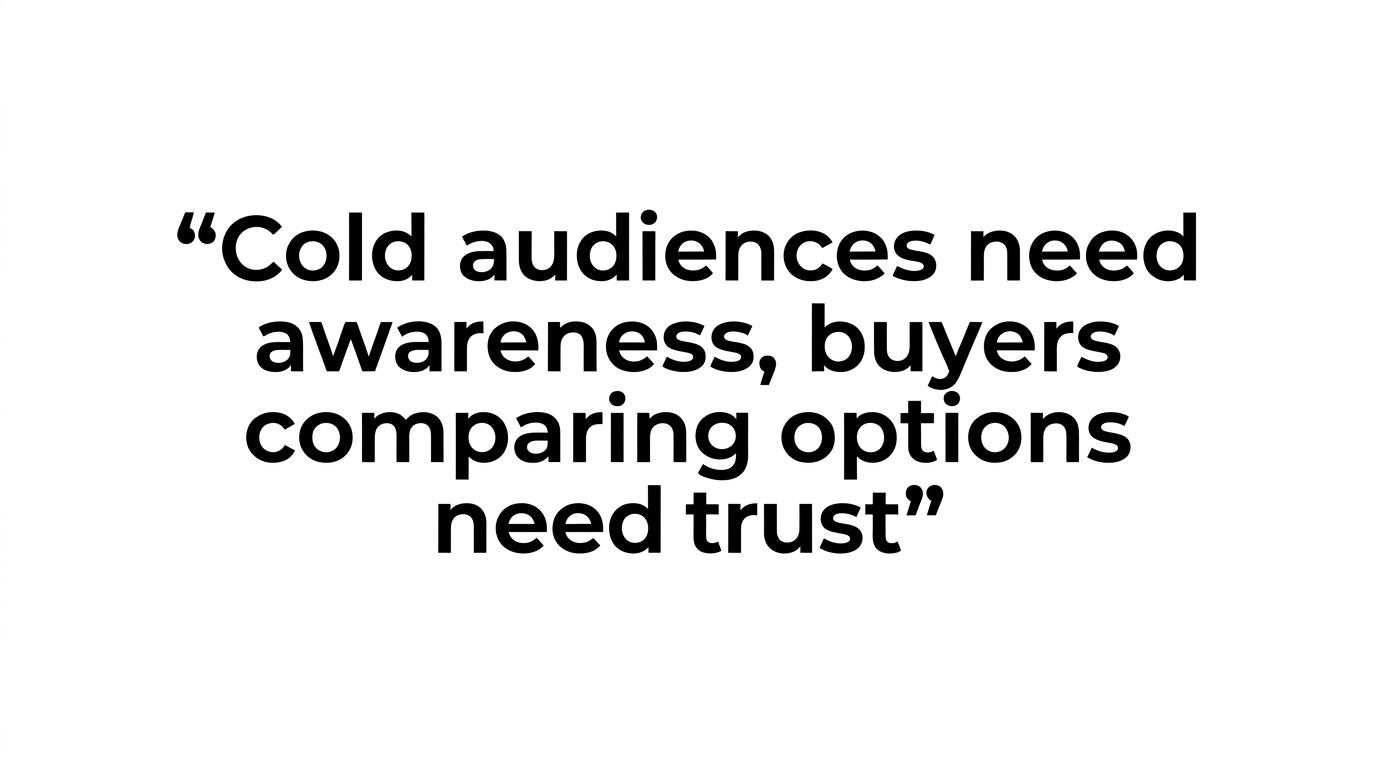
One practical rule helps here. If your sales team keeps explaining why the problem matters, you likely need awareness. If they keep answering “How will this work for us?” you likely need trust.
Should you make one hero product video or multiple channel-specific edits?
Most B2B teams should create one core asset and several channel-specific cuts. Wistia and LinkedIn both suggest that placement shapes performance, so format decisions should not wait until post-production.
Wistia’s 2026 report says 8 in 10 B2B teams name LinkedIn as their primary place to share videos. The same report says videos on homepages, video galleries, and product pages get the highest play rates, with viewers generally getting about halfway through videos on those page types. That means a product-page video and a LinkedIn cut may start from the same footage, but they should not behave the same way.
A hero video gives you message consistency. Shorter edits give you distribution efficiency. The trade-off is budget versus usefulness. One long master may look efficient at first, but it often underperforms across channels. A small edit suite usually works harder: a homepage version, a product-page explainer, a LinkedIn cut, and a sales follow-up version.
If you have to choose, build for your highest-intent placement first. For many B2B brands, that is the product page, not social.
How do you set a success metric before production starts?
Pick one primary KPI and one secondary KPI before scripting. Views, watch time, click-through rate, and qualified meetings answer different business questions.
Here is the cleanest way to do it. If the goal is awareness, track reach, play rate, and engaged view metrics on LinkedIn or other top-of-funnel channels. If the goal is education, look at completion patterns, page engagement, and whether the video reduces repetitive sales questions. If the goal is conversion, measure demo requests, form starts, booked calls, or influenced pipeline on the page where the video lives.
The misconception to avoid is using view count as the universal scoreboard. In B2B, a smaller number of highly qualified views can matter far more than a large number of passive ones. A 45-second product clip watched by operations leaders on a product page may outperform a widely seen social edit that attracts the wrong audience.
We also recommend setting a decision window. Review performance after 30, 60, and 90 days based on traffic volume and sales cycle length. B2B teams with longer buying cycles often need more than one reporting checkpoint before calling a video a win or a miss.
Where should a B2B product video live to get the best results?
High-intent pages usually beat generic distribution on their own. Wistia says homepages, video galleries, and product pages get the highest play rates, which makes those placements central for B2B product video.
That does not mean social is secondary. It means social and site video do different jobs. LinkedIn is often the entry point. The product page is often where intent gets tested. One catches interest; the other helps turn that interest into action.
For Edmonton companies selling complex services, software, equipment, or education-related products, placement should follow buyer behaviour. Put the shortest, clearest version where first contact happens. Put the most useful explanatory version where comparison happens. Put sales-enablement edits where reps can send them after meetings.
If your team only publishes on social, you are relying on rented attention. If your team only publishes on-site, you may miss awareness. The right mix depends on whether you need more market education or more bottom-funnel movement right now.
How do you brief a product video company in Edmonton without slowing approvals?
A strong brief names the audience, objective, timeline, decision makers, locations, and deliverables before creative development starts. Q Filmz Media uses that planning logic because it protects budget, speeds approvals, and keeps product messaging sharp.
Start with the audience and the business objective. Say who the video is for, what stage they are in, and what action you want next. Then define decision makers on your side. If marketing, sales, product, and leadership all need sign-off, capture that early so feedback does not change the goal halfway through editing.
Next, outline the practical conditions. In Edmonton, location access, facility safety rules, seasonal light, interview availability, and product readiness affect schedule more than many teams expect. If the product is physical, note whether it needs staging, customer-facing environments, or drone footage. If the product is digital, decide whether on-screen capture, animation, or live-action context will carry the message best.
Last, decide the deliverables before production starts. A product-page edit, LinkedIn cut, sales follow-up version, and stills package may all come from one shoot, but only if the shoot is designed for that output. We cover this kind of planning across our product video work, corporate video production in Edmonton, and broader Edmonton video production services.
Ready to sharpen your product video strategy in Edmonton? Contact Q Filmz Media today for a free project consultation and quote.